How to Cue Yoga Poses So Beginners Can Follow
One day, a student and I were looking at a photo of her own tabletop pose: hands and knees on the mat. I pointed her towards her hands and shoulders.
Then I asked: imagine the person in this photo is your student. What would you say to help them change it?
She said she would just tell them to push their body forward a little.
I asked: which part is "body"?
As I asked it, I felt a bit fussy. She answered honestly that she didn't know which part to name.
That answer didn't stall the lesson. It showed both of us where to practise next.
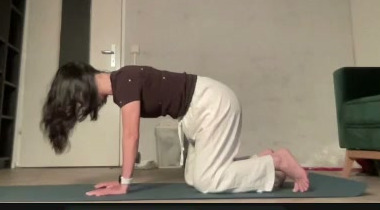
Her idea was going in the right direction. But the person practising can't see the picture in the teacher's head. They only hear the word "body", and that word is too wide.
If you are training to teach yoga, you may know this feeling. Your eyes see what isn't working. When you open your mouth, the words don't come.
That doesn't mean you aren't suited to teaching. Saying what you see is its own skill, and skills can be practised.
I wrote this article for the gap between seeing and saying.
In short
- When I cue a yoga pose, I name the body part that moves, the action, and the direction. A short cue that is vague is still hard to follow.
- Students listen while they move. Say one action at a time.
- After you speak, watch and listen. When a student says they can't keep up, change the cue. Don't repeat the old one.
- Seeing it but not yet being able to say it is normal when you start teaching. You can practise this.
In this article
- 1. Why is "I don't know" a good answer?
- 2. Is a short cue always a clear cue?
- 3. Students are busy. How much can they hear?
- 4. One word, "neutral". Why two opposite directions?
- 5. When a student says "I can't keep up", what do I do?
- 6. How do you practise cueing until it comes naturally?
- 7. Where do you practise this in a 200-hour training?
- What does the research say?
- Questions people often ask
- Last words
- Read more
- References
1. Why is "I don't know" a good answer?
When you get stuck on a question, it's tempting to say anything just to fill the silence. Especially when you are training to stand in front of other people.
My student said plainly what she didn't know yet. So the question didn't hang in the air. I could explain right away, on the photo we were both looking at.
I told her: the everyday way of saying it wasn't wrong in meaning. It just wasn't clear enough to be a cue.
Then we looked at which words to change and which to keep. For that photo, I chose to cue move your shoulder blades slightly forward, instead of moving the hands. What she needed to practise next was naming the part of the body she wanted the student to notice.
Changing "body" to "shoulder blades" makes the sentence much more specific. But it isn't finished: you still need to see whether the listener understands and can do it.
And that was the cue for that one photo. Another person, another pose, may need a different sentence.
2. Is a short cue always a clear cue?
Try it now, before you read on
You are in tabletop. The teacher says: "Push up." What do you do?
Lift my hips: the person next to you may do something else. Same two words, different readings. That is the point of this section.
Press my hands into the floor: a reasonable reading. But the teacher may have meant something else. You had to guess.
Lift my chest and look up: also a possible reading. The teacher didn't say which part or which direction, so everyone chooses for themselves.
I don't know what to do: a very honest answer. The listener has to guess: up with which part, up in which direction?
There is no right answer. That's exactly why this cue needs to be clearer.
"Push up" is only two words. The listener still has to guess: which part, and up in which direction?
So I don't judge a cue by how few words it has. I only ask: does the listener have to guess?
Three questions to check a cue
- Which part?Hands, feet, knees, shoulder blades. Left or right, when it matters.
- Doing what?Place, lift, lower, step, hold, release.
- Where to?Forward, back, down to the mat, between your hands.
VaguePut your hands in position.
ClearerPlace both hands on your hips.
VaguePush your body forward a little.
ClearerMove your shoulder blades slightly forward.
The cue I chose for that tabletop photo (section 1). Another person or pose may need a different one.
If the listener doesn't know where their shoulder blades are, show them, or say it another way. Swapping a vague word for an anatomy word they don't understand isn't finished either.
3. Students are busy. How much can they hear?
In the lesson, I took an example straight from cueing a Sun Salutation.
The teacher calls: breathe in, raise both arms. Then adds a whole string: feet like this, hands like that, back straight, look here. While the student is still busy getting their foot back to the right place.
I used the word "load" to explain why it's hard to take in many cues at once.
When two people sit and talk theory, a longer sentence is fine. When someone is moving their feet on the mat, their body is busy too. The same amount of words, said at that moment, is much harder to follow.
So each time I cue, I focus on one action. I speak slowly. The explanation of why can wait for a pause.
Two examples: one action per cue
Warrior 3. She couldn't yet do two things at once, so I didn't combine them just to make the cue sound smooth.
- Fold your upper body forward
- Then send your leg back
Hip warm-up. When you reverse direction, say the steps again.
- Bring your knee up in front
- Open it out to the side
- Lower it down
There is one thing I often tell trainees: you don't need to make a class harder to prove you're a good teacher. Making something hard easy to understand is the teacher's job.
4. One word, "neutral". Why two opposite directions?
Teachers say "keep your neck neutral" and understand each other. Beginners may not.
In the lesson, I gave her two ways of saying it, in opposite directions.
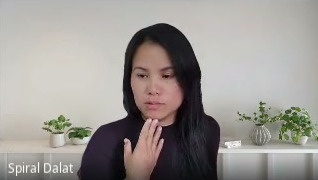
"Keep your neck neutral": two opposite cues
The neck is tipped back
Cue: bring your chin a little towards the notch of your chest.
The chin is pressed down too much
Cue: bring your chin out a little.
A cue that is right for one person can be wrong for another. Don't memorise a list of "correct cues": look at the person in front of you, choose a sentence, then look again to see how they changed.
If you practise on your own, don't adjust your neck based on this example without someone watching.
You still need to learn the technical names, because teachers need to talk to each other precisely. But in front of a class, you have to say it in everyday words. For the theory of alignment, you can read what alignment in yoga means.
5. When a student says "I can't keep up", what do I do?
When we got to Sun Salutation, in the middle of the sequence, she said she couldn't follow the breathing rhythm.
I changed straight away: just breathe normally. From then on, I mostly called the name of the movement and which leg, and every now and then reminded her to keep breathing normally.
It's a small moment. But it's where new teachers often miss something: the cue you prepared matters less than the person practising in front of you.
She said it out loud, and that helped me. I could see her pose, but only she could know whether she was out of breath or fine. With that sentence, I knew what to change.
Some people need to hear the explanation again. Some already understand, but need more time or a more suitable way to practise. To know which one it is, you have to ask, not just repeat the same sentence.
Breathing normally doesn't mean keeping the old speed either. If it's too much, slow down or rest. I write more about breath in how to breathe in yoga. And I tell more of this lesson, about learning the sequence before the breath can keep up, in Sun Salutation for beginners.
6. How do you practise cueing until it comes naturally?
Start very small: a section of a sequence you have already learned with a teacher. Don't take on correcting difficult poses or other people's aches and pains.
- Write it downKeep only the cue into the pose, one thing you want the student to notice, and the cue out. Underline the vague words: "body", "there", "into position".
- Say it out loudIs there a sentence with three actions at once? Did you say left or right where it matters? Is there a word only you understand because you can see it, and the listener can't?
- Ask your trainer to listenAsk specific questions: which sentence wasn't clear, which step came too late. When you cue other people, do it within your assigned practice, with a trainer watching.
- Fix one thing, then cue againThe first time you said "push your body", next time you name "shoulder blades". That's one step forward. You don't need to fix your voice, pace, pose names and everything else in one round.
When you give yourself feedback, also notice what you already did well. Like my student here: I had only pointed her to an area, and she suggested a direction to adjust. Her next step was naming the part that should change. Learning to teach goes step by step like this. It doesn't divide people into good and not good.
7. Where do you practise this in a 200-hour training?
If you are choosing a yoga teacher training, ask the school three questions: who will I practise cueing with, who watches me cue, and where do I get corrected and try again?
Yoga Alliance's RYS 200 standards include teaching methodology, covering cueing, class pacing and sequencing. The practicum mentions being supervised and receiving feedback.4 Learning to teach is more than learning pose names.
My 200-hour online training: how are the 200 hours split?
- 80 hoursLive guidance with me on Zoom.
- 60 hoursTeaching practice. You invite the people you teach; I watch you teach live on Zoom and give feedback.
- 40 hoursAlignment, anatomy and breath theory.
- 20 hoursPhilosophy and assessment.
I'm based in Vietnam (GMT+7). The live schedule is checked with you against your time zone before you enrol. Details are on my 200-hour online yoga teacher training page.
When you complete the programme requirements, the school issues a certificate of completion. Registering as an RYT 200 with Yoga Alliance is a separate step. I explain it in online yoga teacher training and Yoga Alliance.
With a certificate, you still have to practise speaking. And cueing one class smoothly doesn't mean you can teach every body.
What does the research say?
Research on feedback and cues
The studies below come from physical education and motor learning, not yoga specifically.
2021 · Review of 23 studies in physical education
Students who got feedback learned motor skills better than those who didn't. Evidence on whether visual or verbal feedback works better is still limited.1
There's no "scientifically correct" cue to memorise. Every cue has to be tried with real people.
Questions people often ask
I don't remember all the pose names yet. How can I cue other people?
My student in this lesson asked exactly that: if I can't remember them myself, how do I help others? My answer: you don't need to memorise everything before you start. Understand poses by family and shape: forward folds, backbends, twists, balances… A seated forward fold with one leg bent or both legs straight is the same family, just a different variation. When you practise explaining to someone else, you also find out how much you really understand.
Is saying less always better?
No. A short cue that leaves out which leg, which direction, or how to come out of the pose is still hard to follow. You need to be clear enough at the right moment, not hit a word count.
Do beginners have to follow the exact breath rhythm I call?
Don't force it. In the lesson I describe here, she said it was hard to follow, so I let her breathe normally. If it still feels like too much, stop and learn one part at a time.
Can you practise cueing in an online course?
The lesson in this article was online. We looked at photos of poses, talked back and forth and fixed one sentence at a time. Learning from a distance still needs observation, practice and feedback. Before you enrol, ask clearly how the course you are choosing does those things.
Last words
From that lesson, I want to keep two moments. When she said she didn't know which part of the body to name. And when she said she couldn't keep up with the breath.
The first told me I needed to explain more. The second told me I needed to change my cue.
Saying what you don't know, or can't do yet, isn't easy. When you teach, you will need students who dare to say it too. Let them see that you are willing to listen, and willing to practise again with them.
Speak, then listen.
Read more
- How to observe and adjust a student's yoga pose
- Sun Salutation for beginners: what if your breath can't keep up?
- What is alignment in yoga?
- How to breathe in yoga
References
The cueing ideas here come from my own teaching. The sources below are for further reading on feedback, attentional cues in motor learning, and training standards.
-
Zhou Y, Shao WD, Wang L (2021). Effects of Feedback on Students' Motor Skill Learning in Physical Education: A Systematic Review. International Journal of Environmental Research and Public Health, 18(12), 6281. DOI: 10.3390/ijerph18126281. A study in physical education, not a trial of online yoga training. ↩
-
Chua LK, Jimenez-Diaz J, Lewthwaite R, Kim T, Wulf G (2021). Superiority of external attentional focus for motor performance and learning: Systematic reviews and meta-analyses. Psychological Bulletin, 147(6), 618–645. DOI: 10.1037/bul0000335. ↩
-
McKay B et al. (2024). Reporting Bias, Not External Focus: A Robust Bayesian Meta-Analysis and Systematic Review of the External Focus of Attention Literature. Psychological Bulletin, 150(11), 1347–1362. DOI: 10.1037/bul0000451. Read together with the 2021 synthesis; don't conclude that one kind of cue is always better. ↩
-
Yoga Alliance. Standards for Registered Yoga Schools, RYS 200: Teaching Methodology and Practicum, printed pages 20–21. Official document. Checked 03/10/2026; these are programme standards, not research on how well a cue works. ↩

Giang Hoang
Yoga teacher, E-RYT 500 & YACEP (Yoga Alliance)
Giang Metta Academy: RYS 200 & RYS 500 (YA ID 442630)
Based in Da Lat, Vietnam. Teaching online worldwide.