How to Breathe in Yoga: Start With Diaphragmatic Breathing
In an online breathing lesson, I had just said that the belly rises when you breathe in. Then I had to add: that doesn't mean pushing your belly out to make it rise.
One sentence that isn't clear enough turns into a different exercise. The belly rises very diligently, and nobody knows where the breath went.
That is why I don't want breathing practice to begin as a contest over who can breathe in longest or breathe out hardest. First, we need to tell the difference between feeling your body breathe and making your body look as if it breathes correctly.
This article is for people new to yoga: understanding diaphragmatic breathing, trying one gentle way to practise it, and then bringing that awareness into poses. I also mention other techniques so you know what you are learning, without turning one article into a list of every breathing method to try on your own.
In this article
- What is diaphragmatic breathing? Does air go into the belly?
- How can a beginner practise diaphragmatic breathing?
- Belly, chest and full breathing: what's the difference?
- Do you need to count 1:1, 1:2 or 1:3?
- How do you link breath and movement?
- Why can breathing practice make you dizzy, and when should you stop?
- When should you learn full breathing, alternate nostril breathing or Ujjayi?
- What are the benefits? How far does the research go?
- Learning to teach: what else do you need besides your own breathing?
- Questions beginners often ask
- Last words
In short
- Diaphragmatic breathing, often called belly breathing, is a way to notice the work of your main breathing muscle. Air goes into your lungs, not into your belly.12
- Start gently, at a level that feels easy. Don't force your belly out, lift your shoulders, or take the biggest breath you can.5
- A breathing ratio (in : out) is a way to organise time. It is not a ranking of skill.
- In poses, don't hold a shape by forgetting to breathe. Make the pose easier so you can keep noticing your breath.
- If you feel dizzy or unwell, stop. If you are so short of breath you can't speak, or your chest feels tight or heavy, get emergency medical help straight away. Don't keep practising breathing.1012
What is diaphragmatic breathing? Does air go into the belly?
The diaphragm is a dome-shaped sheet of muscle under your lungs, between the chest and the abdomen. When you breathe in, it contracts and moves down, and the chest gets more space so the lungs can expand. When you breathe out at rest, it relaxes and goes back to its dome shape.13
That movement can make your belly move out a little and then come back. You are feeling an outside movement of the body. Air is not running down into your stomach. Air goes through your airways into your lungs, and oxygen passes into the blood from there.23
In class, "breathe into your belly" can help a learner know where to put their attention. But if you take it as a description of anatomy, it's wrong.
I want to keep cues easy to understand, and still be clear about their limits. A picture that helps you practise doesn't have to become a different story about the body.
Does the diaphragm work when I'm not paying attention?
Yes. The diaphragm is the main breathing muscle, and breathing usually happens automatically. You don't have to control each breath for the diaphragm to work.4
So what do we learn when we practise?
We choose to observe: am I rushing to take a breath, am I pushing my belly out, am I breathing out or holding? Paying attention to your breath is different from your body needing your attention to breathe.
Seeing this also takes away one burden: you don't need to control your breath all day to prove you have learned yoga.
How can a beginner practise diaphragmatic breathing?
First, choose a time when you feel fine. Not a time when you are short of breath or trying to get through dizziness. If you have a heart or lung condition, blood pressure problems, are pregnant, or already have your own breathing instructions, ask the health professional who looks after you before adding or changing a technique.13
What follows is a gentle introduction. It is not a lung function test or a treatment programme.
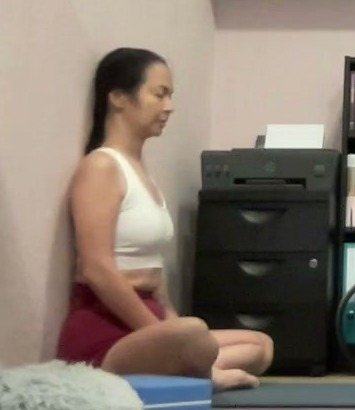
1. Choose a position you don't have to hold
You can sit on a chair with your feet on the floor and your back supported. Or lie on your back comfortably, with something under your head and knees if you need it. Loosen anything tight around your belly.53
You don't need a perfect cross-legged seat to learn to breathe.
For observing, I prefer a position that doesn't take all your attention to hold. If you sit and only think about numb legs or a tired back, change your support. Don't put up with it just to finish the shape.
2. Observe before you change anything
Place one hand lightly on your upper chest and the other on your belly, just below your ribs. Breathe as usual and feel which hand moves. This is a way to notice movement, not a diagnosis.36
No counting yet. No making the belly rise more.
You can ask yourself three questions: am I holding my belly hard? Am I lifting my shoulders? Am I holding my breath because I'm concentrating too much? You don't have to find a mistake. Sometimes noticing that you don't yet know how to observe is a clear place to start.
3. Breathe in gently, and let the belly move with the breath
Try breathing in gently through your nose, if your nose is clear. Let your belly expand a little under your hand. Don't push with your hand or arch your belly out.56
I don't use how much the belly rises as a score. The aim of this round is to tell two things apart: breathing in and noticing the movement, and pushing the belly to create the movement.
If it isn't clear yet, go back to normal breathing and try with less. You don't need to make it big enough to see.
4. Breathe out softly, without squeezing out every last bit
Let the breath go out gently. In this introduction, there is no need to stretch it so long that you have to gasp for the next breath.5
A common misunderstanding is that you must push all the old air out before new air can come in. After a normal breath out, there is still air in your lungs. That is part of how breathing works, not proof that you did it wrong.7
So "completely empty lungs" is not the goal of this exercise.
Do a little, and know what you just did
You can try a short round of a few breaths, rest, then ask: was it easy? Was I straining in my belly or neck? Do I want to stop? Breaking it into small rounds just makes it easier to observe. I don't set a number of breaths or minutes to reach.
When it doesn't feel comfortable yet, you don't need more time. The NHS guidance also stresses breathing within a comfortable limit, not forcing it deep.5
Belly, chest and full breathing: what's the difference?
In my lessons, I separate breathing into types so learners have something to observe. But the names we use in class don't mean the body works in separate parts.
| What we call it in class | What you notice | What not to conclude |
|---|---|---|
| Belly / diaphragmatic breathing | The belly moving with the breath | Air goes into the belly; the more the belly rises, the better |
| Chest breathing | Movement you can easily see in the ribcage | Any chest movement means you're breathing wrong |
| Full breathing | Belly and ribcage both taking part, in a specific exercise | You must lift your shoulders or take a maximum breath every time |
The muscles between the ribs also help widen the chest when you breathe in. So a cue like "don't lift your chest too much" in one exercise shouldn't become a rule to keep your ribcage still in everything you do.1
When you climb stairs or exercise, your body needs more air, and your breath may get faster. That doesn't mean you forgot diaphragmatic breathing or are doing it wrong.4
I keep learning to observe at rest separate from how the body responds when you move. One picture of a belly rising slowly while lying down shouldn't be used to grade every breath in your day.
With full breathing, beginners don't need to turn three areas of the body into three clear stages. In this article, I don't ask you to lift your shoulders to prove how high the breath went. If you are still caught between breathing and trying to make a shape, go back to the basics first.
Do you need to count 1:1, 1:2 or 1:3?
You don't have to count from the start. Counting is a tool to notice time. It doesn't replace what the person practising feels.
In my lesson, I stop at the word ratio. Breathing in for three seconds and out for three seconds is 1:1. Four and four is also 1:1. Same ratio, different speed.
| Ratio (in : out) | What it means | What not to assume |
|---|---|---|
| 1:1 | The two parts take the same time | Each part must be exactly one second |
| 1:2 | Breathing out takes twice as long as breathing in | Everyone must manage double |
| 1:3 | Breathing out takes three times as long | This is a higher level, or always better |
This table explains the notation. It is not a programme to level up from 1:1 to 1:3.
The same number doesn't mean the same experience
If counting helps you slow down, count silently at a pace that feels easy. If you keep chasing the last number, stop counting and go back to observing. You don't need to squeeze your breath to fit your teacher's count.5
Also, don't mix up slow breathing with a lot of breathing. Someone can stretch each breath and still try to take in far too much air. That's why I ask "am I straining?" and not only "how many seconds?".
Is a longer breath out always better?
We can't say that. A 12-week trial by Birdee and colleagues with 100 healthy adults compared two kinds of slow breathing: breathing out longer than breathing in, and both parts equal. Both groups reported less anxiety. The difference between the groups was small and not statistically significant, including for heart rate variability.8
That doesn't prove the two ways are identical for everyone. But it doesn't support the idea that a longer breath out is always more helpful.
For a beginners' article, I choose something simpler: find a pace you can do gently first. Don't use ratios to manage your own blood pressure or dizzy spells, or to replace your doctor's advice.14
How do you link breath and movement?
In my alignment lessons, I cue three things: where the body is, where you look, and the breath. If you can hold a shape but only by holding your breath, I want to look at how you practise before making it harder.
You can read my article on alignment in yoga for the body position part. Here, I only focus on not forgetting the breath when you start to move.
Separate first, combine later
One way to start is a small movement, like raising both arms within a comfortable range and lowering them. The aim is to practise linking breath with movement, not to reach higher.
- Try the movement on its own, without forcing the reach.
- Then try breathing in as you raise your arms, and out as you lower them.
- If you run out of breath before your arms get there, raise them less or make the movement smaller. Don't hold your breath and wait for your arms.
- When you have too many things to think about at once, stop moving, breathe normally, and practise one part at a time.
This is a simple pattern for practice. It is not a rule for every yoga pose. When you learn a specific sequence, follow the cues for that sequence and say so if the count is too long for you.
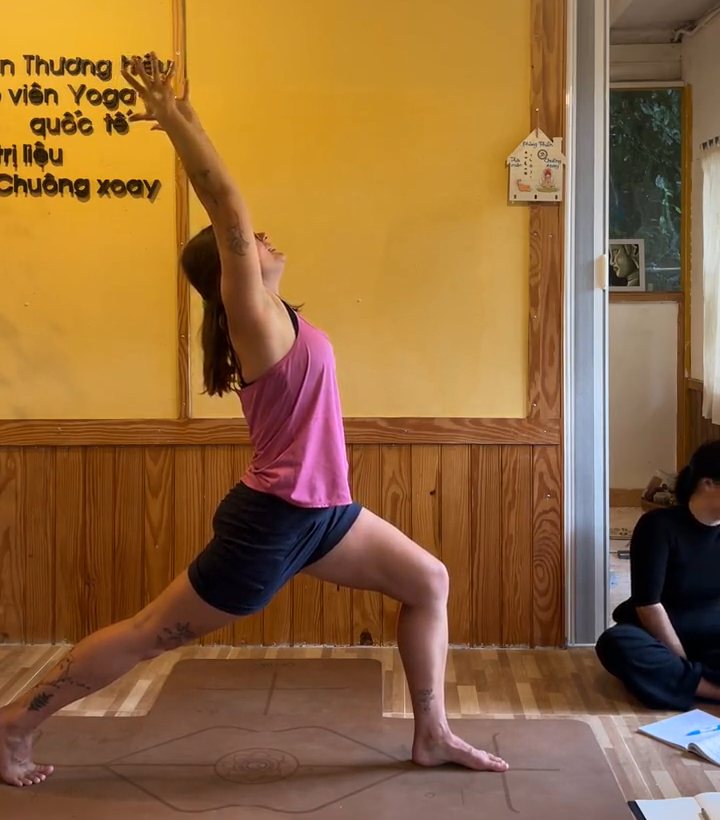
Holding a pose doesn't mean holding your breath
Some poses ask you to stay for a few breaths. You don't go into the shape and wait until you come out to breathe again.
At first, you can use a reminder: my arms and legs are here, my breath is still moving. I don't expect that sentence to make the pose deeper. It just helps you notice the part you forgot.
If you have to grip to stay there, use support or choose an easier version with your teacher. This is the same idea as in my article for people who feel too stiff for yoga: break learning into parts, and don't make the final shape a condition for starting.
The teacher has to stop rushing too
In the lesson, I demonstrated two ways of cueing: saying all the instructions back to back, then saying them again more slowly, with pauses.
You can't ask students to take their time while you read out instructions as if you're running out of time. Learners need to hear what you are asking before they can do it.
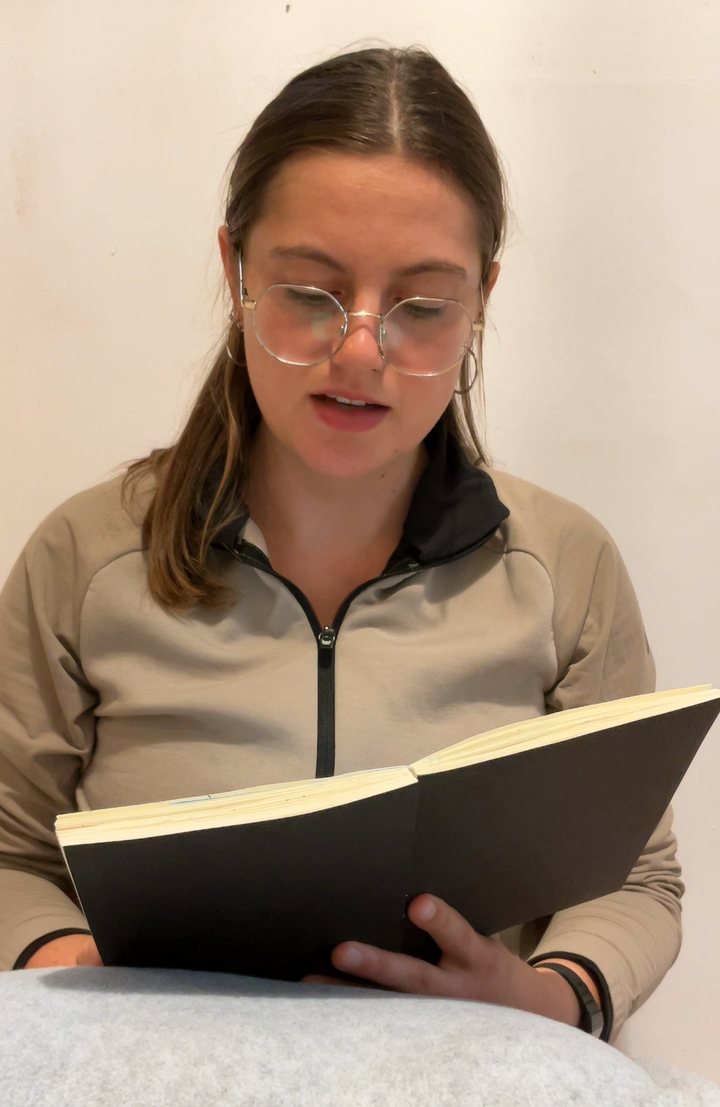
If you keep running out of breath in class, you can say something very specific: "This is where I run out of air." That helps your teacher adjust much more than "I'm bad at breathing".
Why can breathing practice make you dizzy, and when should you stop?
Dizziness is not a sign to keep going until you get used to it. Stop the exercise, go back to natural breathing, and sit or lie down somewhere safe. Don't stand up quickly or carry on with a balance pose while you feel dizzy.1011
One possible cause is over-breathing: breathing more than your body needs, which lowers the carbon dioxide (CO₂) in your blood. This can make you lightheaded, or cause numbness around the mouth or in the hands and feet.9
But nobody should see someone feel dizzy and declare the cause is CO₂, low oxygen, low blood pressure or just anxiety. There are many possible causes that need to be checked.9
Not used to it yet, or a sign you need help?
Not remembering the count, looking down at your hands, not knowing where to put your attention: these are things you can learn more slowly.
Dizziness, pain, breathlessness or a feeling that something is wrong: don't push through them with effort. If symptoms don't go away, come back, or have no clear cause, ask a health professional.9
Breathlessness so bad you can't speak, chest pain or tightness, blue lips, or sudden confusion are signs you need emergency medical help. Don't wait to finish practice. Don't try one more breathing ratio to see if it helps.12
If simply focusing on your breath makes you more anxious, you can stop too. You don't have to close your eyes or continue because the person next to you can.
NCCIH notes that relaxation techniques are generally safe for healthy people, but there are rare reports of symptoms getting worse in people with epilepsy, some mental health conditions, or a history of abuse or trauma. If that is you, ask the professional who looks after you first, and practise with someone who has the right training.14
When should you learn full breathing, alternate nostril breathing or Ujjayi?
When you understand what the exercise is for and you have a suitable teacher. Knowing the names of many breathing techniques is not the same as knowing how to use them.
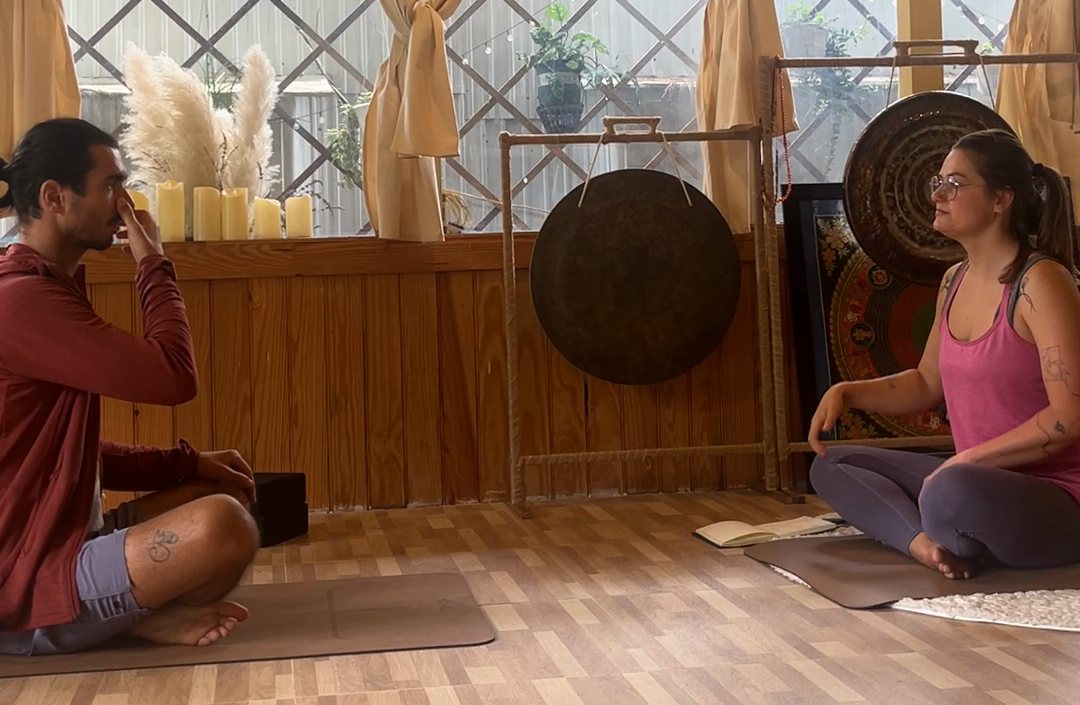
In my lesson, I chose a few techniques so learners could notice the differences. The hard part is not memorising the list. It is knowing what you are doing, whether you are straining, and when to stop.
In brief:
- Alternate nostril breathing: switching sides in a set order. In this lesson, one round meant breathing in left, out right, in right, out left. Each switch is not a full round. This describes what we practised. It is not an invitation to add breath holds or more rounds on your own.
- Ujjayi, often called ocean breath: a soft rushing sound made by adjusting the throat. What I say in class is: gently, no gripping. Beginners don't need to make a loud sound to prove they can do it.
- Kapalabhati: an active, firm breath out, with the breath in happening more passively. It is different from the gentle breathing at the top of this page. Don't speed it up just to look like a demonstration.15
NCCIH advises beginners to avoid forceful breathing practices and to learn with a suitable teacher. People with their own health conditions need adjustments.13
So I don't put breath of fire, long breath holds or pelvic floor locks into this beginning practice. You haven't lost an important part of yoga just because you haven't learned those today.
Learning less, but knowing what you are doing, is still a useful lesson.
What are the benefits? How far does the research go?
There is evidence that breathing practice can help with stress. But don't turn "can help" into "will work for everyone".
A 2023 meta-analysis of 12 trials with 785 adults found a small-to-moderate reduction in self-reported stress. However, most of the studies were rated as having a moderate risk of bias.16
In plain words: the results are worth noticing, but the way the studies were run means I can't treat that improvement as a firm promise.
Also in 2023, a trial with 400 people compared breathing at about 5.5 breaths a minute with a group also guided to pay attention to their breathing, but at 12 breaths a minute. After four weeks, the slower group showed no extra benefit on the psychological outcomes measured.17
A 2024 meta-analysis (31 studies, 1,133 people) also showed the need to separate changes in heart measures from changes in emotion. Slow breathing produced fairly consistent short-term changes in heart measures. The effect on negative emotions, especially perceived stress, was borderline and did not reach statistical significance. Long-term effects on the heart are not established.18
A 2026 study that followed 67 university students for four days found no clear stress reduction in the main analysis. When sessions reported as done incorrectly were removed, one analysis looked more favourable compared with times without practice. Conditional results like this need careful reading. They can't be used to promise long-term effects.19
None of these studies tested the exact introduction at the top of this page. The breathing rates and durations in each study don't automatically become your practice plan.
My balanced takeaway: breathing exercises can be one part of looking after yourself. They are not the answer to every health problem.
You don't need to put long mechanism names into your cues to make a breathing exercise sound stronger. For beginners, knowing how to try gently, notice how you respond and know when to stop is more useful than a big promise.
Learning to teach: what else do you need besides your own breathing?
Doing a technique and guiding someone else through it are two different things.
In this lesson, I spent the last part on taking a breath and speaking slowly. When you start guiding others, you see it: understanding the exercise in your head is not enough. Your sentences need space for people to hear and follow.
One cue, one action
Don't pack feet, hands, belly, neck, gaze and breath into one sentence with no pause. Choose what to say first, wait for the student to do it, then add the next part.
In the same way, when guiding alternate nostril breathing, I want the cue to name the side that is breathing, consistently. Not naming the breathing side and the closed side in the same breath. Counting a full round correctly is also a skill to practise before you stand in front of a class.
Breathe for your sentence, don't make students follow your breath
A small breath in can come before a cue, and the words go out with the breath out. Voice training material from Cambridge University Hospitals also pays attention to coordinating breath and speech, pausing between parts, and not rushing.20
But just because the teacher can take a long breath doesn't mean the whole class has to follow it.
A teacher's practice is not only speaking full sentences. It is also observing, asking, and letting students stop. In an online class, a camera frame that cuts off part of the body can make you judge a pose wrongly. So the camera angle and your questions about how it feels both matter.
Know the limits of an explanation
A teacher can guide students to feel the belly, the ribs and the breath. That doesn't mean you can look through a screen and decide a student is short of oxygen or their blood pressure is changing.
When symptoms appear, your job is not to think of one more breathing technique to fix it. Sometimes your job is to stop the exercise and suggest a medical check.
That is also the hard part of learning to teach: not only adding what you know, but knowing what you shouldn't do in someone else's place.
What I valued in my student that day
The student in that lesson didn't wait to understand everything before asking.
Early in the lesson, she asked: if you practise deep breathing many times, will your breath eventually become deep on its own, without paying attention? I asked her back a few times before I understood exactly what she meant. Thanks to her question, I could clear up a misunderstanding that even people who already teach sometimes have.
While she practised describing an exercise and breathing with her diaphragm at the same time, I asked whether she was breathing with her diaphragm. She answered with exactly what she noticed: some breaths yes, some no. That told me which part to practise again with her.
A few rounds later, she slowed her speech down. I asked which she was paying more attention to. She said both equally. I asked one more question. She paused, then corrected herself: she meant breathing in and breathing out got equal attention, not speaking and breathing.
Noticing that what you just said wasn't quite right, then saying it again more precisely. A teacher needs exactly that.
In the cueing part, she noticed that when I demonstrated, I opened my mouth to take a breath before speaking, while she was used to breathing in through her nose. Trying the cue again with her eyes closed, she found her old habit: one breath, then saying the whole sentence in one go. By the end, she said speaking with the breath divided this way was less tiring.
Not every breath that day was diaphragmatic. But she heard her own breath while she was speaking, and said honestly what she heard.
That is learning to teach.
If you are thinking about training to teach, you can read about my 200-hour online yoga teacher training. Look at how you learn and practise teaching, not only the total number of hours.
Questions beginners often ask
When I breathe in, should my belly go out or in?
In gentle diaphragmatic breathing at rest, the belly usually expands a little as you breathe in and comes back as you breathe out. Don't push it out just to make the shape. In a pose or a specific technique, don't use the belly alone to judge right or wrong.3
Do I have to breathe only through my nose in yoga?
For the gentle exercise at the top of this page, you can breathe in through your nose if it's clear. Breathing guides don't all use one way out: the NHS exercise, for example, uses in through the nose, out through the mouth.5
So ask about the exercise you are doing instead of applying one rule to everything. If your nose is blocked or you feel short of breath, don't close your mouth to force the "correct" form.
My chest still moves. Am I breathing wrong?
You can't conclude that. The ribcage takes part in breathing. In the introduction, the cue to keep the upper chest relatively still is there to help you observe. It doesn't mean the whole ribcage should stop moving.16
How many minutes a day should I practise breathing?
There is no single duration that suits every technique and every person. The NHS exercise suggests at least five minutes; research studies have their own programmes. As a beginner, don't ignore discomfort just to reach a number of minutes.5
I care more about knowing how your practice went before adding time. If you need a personal plan, talk to your teacher about the technique and how you are right now.
Should I breathe very deeply to get more oxygen?
"The more oxygen the better" is not a good goal for practising on your own. Breathing is also about getting rid of CO₂. Over-breathing can make you feel unwell rather than simply adding benefit. If you think you are low on oxygen or short of breath, get a medical check instead of breathing harder.92
Last words
Before you ask how many seconds you managed, try asking: am I trying too hard right now?
Learning to breathe doesn't need to start with six techniques. It can start with noticing that you are pushing your belly, lifting your shoulders, or holding your breath because you are trying to get it right.
Then do a little less.
Breathe within your limits.
References
The teaching ideas in this article come from my own classes. The sources below are for further reading on breathing, safety and the research mentioned.
-
NHLBI, NIH. What Breathing Does for the Body. Updated 27 Jun 2025. ↩↩↩↩
-
NHLBI, NIH. How the Lungs Work: The Lungs. ↩↩↩
-
Cambridge University Hospitals NHS Foundation Trust. Breathing pattern disorders and physiotherapy. ↩↩↩↩↩
-
NHLBI, NIH. How Your Body Controls Breathing. ↩↩
-
Cleveland Clinic. Diaphragmatic Breathing. ↩↩↩
-
NHLBI, NIH. Pulmonary Function Tests, Lung Volumes section — the air left in the lungs at the end of a breath out. ↩
-
Birdee G et al. Slow breathing for reducing stress: The effect of extending exhale. Complementary Therapies in Medicine. 2023;73:102937. DOI: 10.1016/j.ctim.2023.102937. Full text: PMC10395759. ↩
-
MedlinePlus, U.S. National Library of Medicine. Hyperventilation. ↩↩↩↩
-
Ashford and St Peter's Hospitals NHS Foundation Trust. Nervous System Regulation, Breathing Exercises section. ↩↩
-
NHS. Shortness of breath. ↩↩
-
NCCIH, NIH. Yoga: Effectiveness and Safety, risks and adapting practice to health conditions. ↩↩
-
NCCIH, NIH. Relaxation Techniques: What You Need To Know, blood pressure and safety. ↩↩
-
Morarji Desai National Institute of Yoga, Ministry of Ayush. Yoga for Adolescents, printed page 60: active breath out, passive breath in. ↩
-
Fincham GW et al. Effect of breathwork on stress and mental health: A meta-analysis of randomised-controlled trials. Scientific Reports. 2023;13:432. DOI: 10.1038/s41598-022-27247-y. ↩
-
Fincham GW, Strauss C, Cavanagh K. Effect of coherent breathing on mental health and wellbeing: a randomised placebo-controlled trial. Scientific Reports. 2023;13:22141. DOI: 10.1038/s41598-023-49279-8. ↩
-
Shao R, Man ISC, Lee TMC. The Effect of Slow-Paced Breathing on Cardiovascular and Emotion Functions: A Meta-Analysis and Systematic Review. Mindfulness. 2024;15:1–18. DOI: 10.1007/s12671-023-02294-2. ↩
-
Bamert M, Rink JM, Inauen J. The immediate perceived and physiological stress-lowering effect of slow-paced breathing in daily life. Psychology & Health. Published online 13 Apr 2026. DOI: 10.1080/08870446.2026.2653702. PubMed: 41972357. ↩
-
Cambridge University Hospitals NHS Foundation Trust. Breathing exercises, voice training material. ↩

Giang Hoang
Yoga teacher, E-RYT 500 & YACEP (Yoga Alliance)
Giang Metta Academy: RYS 200 & RYS 500 (YA ID 442630)
Based in Da Lat, Vietnam. Teaching online worldwide.