Online or in person in Da LatFor beginners

Singing Bowls
& Restorative Yoga

Understand the body.
Lead bowl sessions with more care.

The bowl is still ringing, but the person lying down keeps shifting. They haven’t found a comfortable position yet. That’s when I check the support, not just change the sound.

Fees from13 million ₫Early Bird 11.7 million ₫ for the first registrant in each group class

Group or 1:1 · 30 hours with your teacher + 20 hours of guided self-practice.

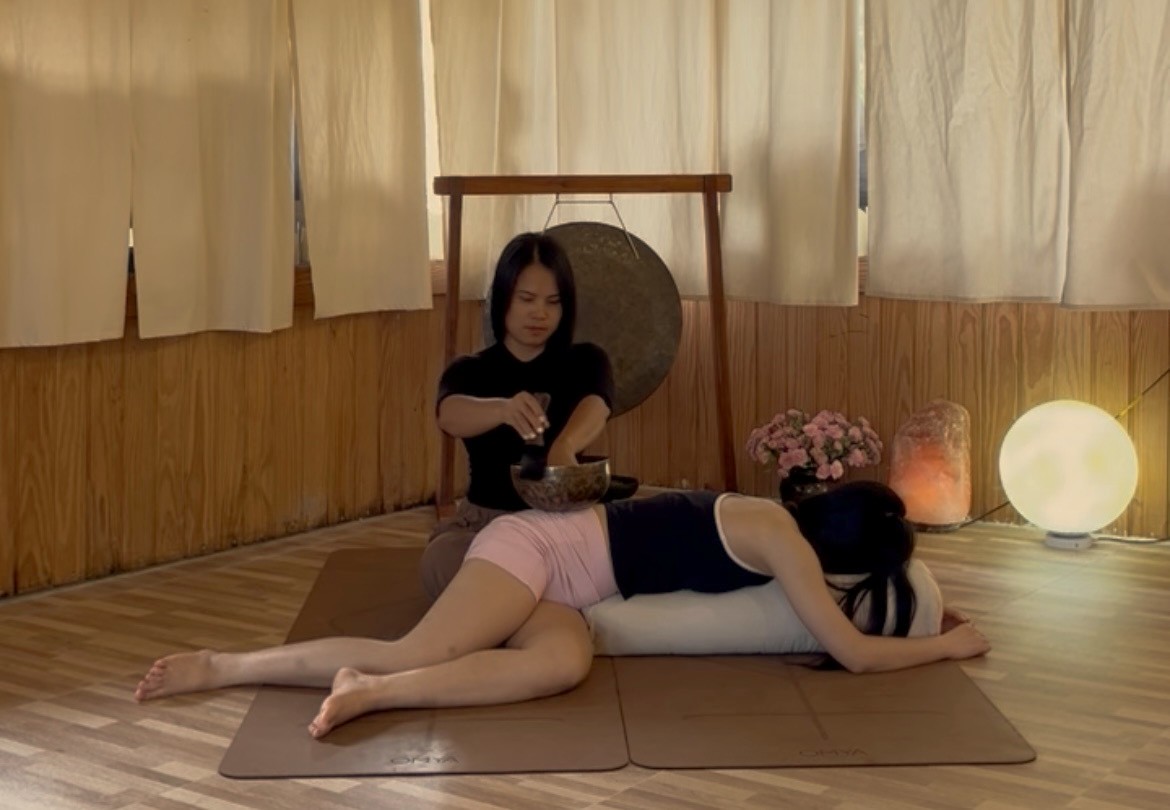
A student lies face down over a long bolster, legs bent to one side; the teacher sits beside her holding a singing bowl
She rests over a bolster; the person leading the bowls sits right beside her.
30H

Singing bowls

20H

Restorative yoga

50H

One program

Two parts that support each other in one program.

Online and in person both include 30 hours with your teacher and 20 hours of guided self-practice.

Why learn them together?

If you lead bowls,
you also need to know
how a body rests.

The restorative yoga part focuses on what you need when you lead bowls: understanding the body, choosing support, and helping the person lying down find a resting position that suits them.

You feel it in your own body first, then practise observing and asking others. Lying still doesn’t always mean comfortable.

Support the body, not just set out bowls

Basic anatomy and hands-on practice with pillows, blankets and bolsters help you choose where to support. When the setup is ready, you ask the person lying down instead of guessing they feel fine.

Cues that follow what the person needs

You practise short cues, then wait while the person adjusts and tells you how it feels. In the bowl part, you practise volume, silence and transitions.

Notice your own posture too

You also watch how you sit, stand, hold the mallet and move around the mat. Bowl practice isn’t only hand training; it’s also noticing where you hold tension.

See how Giang teaches observing the person lying down →

What you learn · from basics to practice

Understand the person lying down.
Then choose how to lead.

Learn how to support the body and how to use sound, so each part helps the other when you practise.

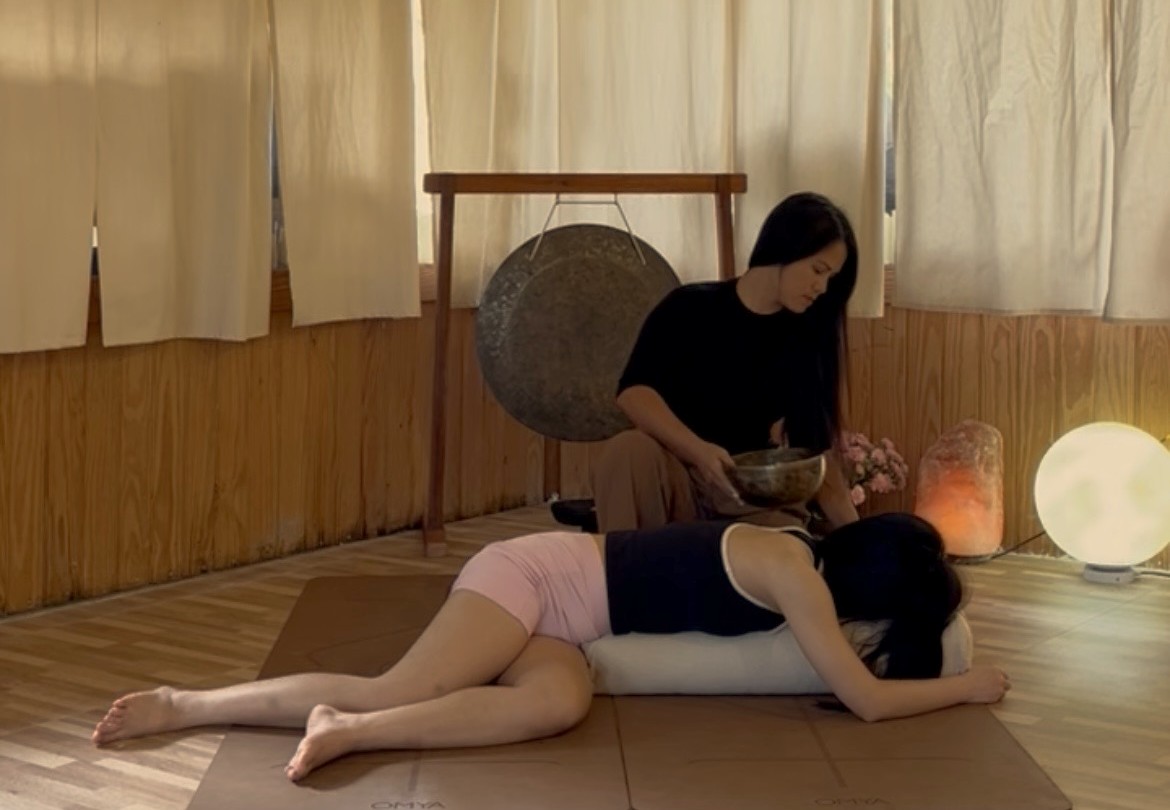
The teacher plays a bowl near the upper back of a student resting her torso on a bolster
Playing a bowl while the student rests her torso on a bolster.

30 hours / Sound & observation

Singing bowls

Hands on the bowl.
Eyes on the person.

Choose Tibetan or crystal singing bowls. Learn technique from the start, and practise noticing the person who is listening.

Listen and control your technique
  • Understand the bowls you use, their overtones, and how to listen to the ringing sound.
  • Practise holding the mallet, striking, rimming, and controlling pressure and volume.
  • Move between bowls; get to know the gong as part of the foundation program.
Prepare the resting space and practice room
  • Use what you learn in restorative yoga to set up the pose, pillows and blankets before you place the bowls.
  • Arrange the bowls, leave a walkway and choose where to stand so you can see the person lying down.
  • Ask if the person is comfortable before you begin.
Lead the session by the person’s feedback
  • Plan the opening, the sound part and the closing of a Sound Bath.
  • Practise cues, sound transitions and silence.
  • Observe, check in and adjust when the person lying down needs a change.
Practice with feedback
  • Record your practice to get feedback on technique, setup and cues.
  • Learn safety principles and the limits of practice.
  • Placing bowls on the body is part of the Tibetan bowl track only, learned with guidance; it does not apply to crystal bowls.
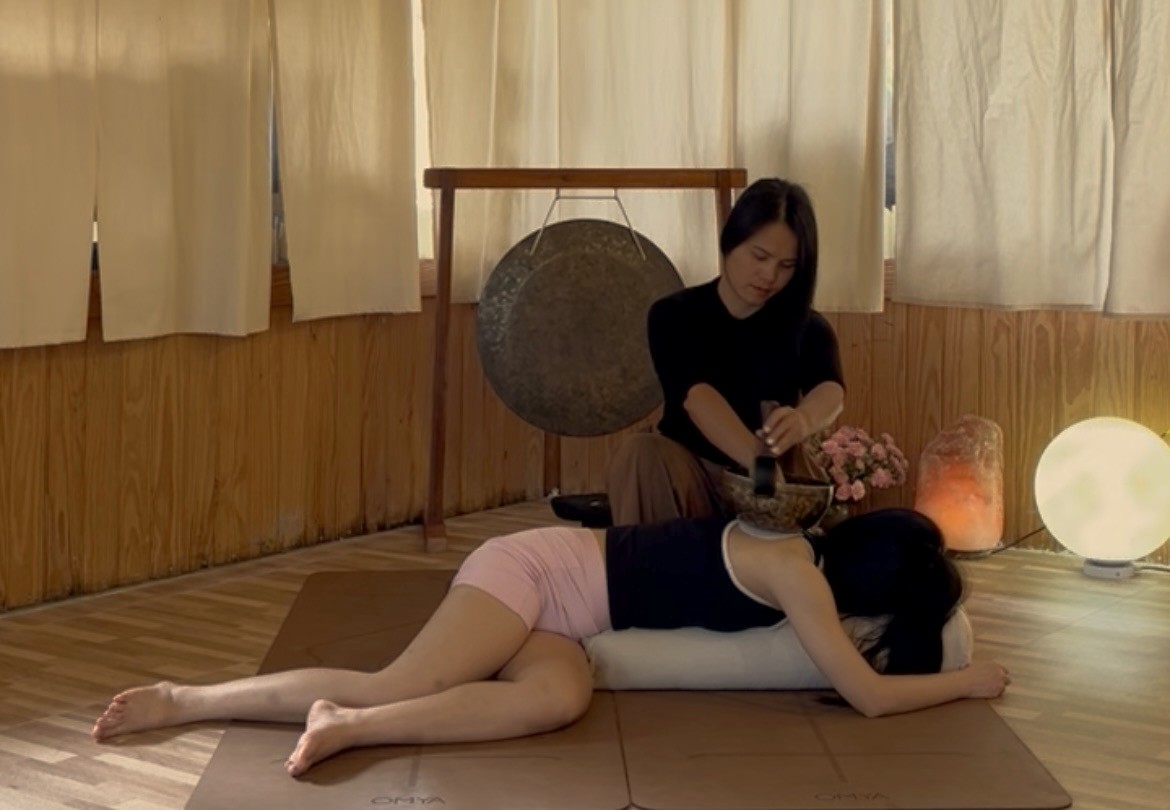
A student rests her torso on a long bolster with knees bent, while the teacher plays a bowl beside her
A bolster supports the torso in a resting pose, together with the bowls.

20 hours / Foundations of support

Restorative yoga

Prepare the body
before the first sound.

The yoga part is for beginners. It focuses on what you will use when you prepare and guide a bowl session.

Understand the body in resting poses
  • Get to know the spine, hips, shoulders and knees through practice.
  • Notice how people differ; one way of propping doesn’t fit everyone.
  • Practise observing and asking how it feels, instead of guessing for the person lying down.
Use props for support
  • Get to know pillows, blankets, bolsters and other suitable props.
  • Practise choosing where to support, adjust it, then check again with the person.
  • Use this when you prepare a resting space for a sound session.
Breath, cues and resting time
  • Try resting poses yourself and notice your own breath and sensations.
  • Practise simple cues without pushing the person to relax.
  • Learn how to come into, stay in and come out of a pose; link this to the opening and closing of a bowl session.
Bring restorative yoga into your bowl practice
  • Choose resting poses and props for each person lying down.
  • Explain why you chose that support, those cues and that order.
  • Practise, record your work and refine it with Giang’s feedback.

Where the two parts meet in practice

Not just listening to bowls.
Learning to listen to people.

Example: the person lying down says their shoulder isn’t comfortable. You talk with them, adjust the support you learned, and ask again before you continue. While you play, you keep watching how they respond, not only your technique.

  1. 01Ask what
    the person needs
  2. 02Choose the pose
    and support
  3. 03Check again:
    comfortable now?
  4. 04Lead the bowls
    while observing
  5. 05Ask for feedback
    and adjust

Restorative yoga helps you understand support.
Bowl practice helps you do it with a real person.

How you learn · same total hours

30 hours with Giang.
20 hours of guided self-practice.

This is the same online and in person, in groups and 1:1. You learn how, practise on your own, get feedback, then try again.

30 hours · with your teacher

Someone guides you while you work.

Online: live on Zoom with Giang.

In Da Lat: in person with Giang at the studio.

From bowl technique and propping to cues. You try it, ask about what’s unclear and get feedback during the session.

20 hours · guided self-practice

Practise alone to find where you get stuck.

Practise the tasks you are given: bowl technique, resting poses, using props and the combined practice.

Note what’s unclear, record your practice when asked and adjust after feedback. It’s not 20 hours of watching videos and guessing whether you’re doing it right.

Two ways to split the same 50H course: by content, it’s 30H singing bowls + 20H restorative yoga; by how you learn, it’s 30 hours with your teacher + 20 hours of guided self-practice. Both subjects appear in both parts.

Choose the way of learning that suits you

Online

Prepare a device with a camera and microphone, a stable connection and a camera angle that shows your hands clearly. Before we start, I look at your space and the props you already have with you.

In person in Da Lat

Learn at the studio on dates we agree on. Talk with Giang about dates before you book flights and accommodation; the self-practice hours are still part of the program.

Don’t rush to buy a full set of bowls. Talk it through first: bowl types, props and what you already have.

If you keep learning at Giang Metta

Learn today.
Build toward what comes next.

Your course hours are recorded by subject, toward the singing bowl and yoga certificate pathways at Giang Metta.

30H

Counts toward a singing bowl certificate

Your 30 hours of singing bowls are recorded for the singing bowl certificate pathway when you continue learning at Giang Metta.

Explore the singing bowl trainings →
20H

Counts toward a yoga certificate

Your 20 hours of restorative yoga are recorded for the yoga certificate pathway when you continue learning at Giang Metta.

Explore the yoga trainings →

The two sets of hours are recorded separately by subject, after you complete the content and the matching assessment.

Fees · full 50-hour program

Online or Da Lat.
Choose how you learn with Giang.

Fee per person, including singing bowls and restorative yoga.

Online

Live on Zoom

Group of 3+

13 million ₫

Early Bird 11.7 million ₫

Private 1:1

16 million ₫

No Early
Bird discount

Ask about online classes

Da Lat

In person at the studio

Group of 3+

16 million ₫

Early Bird 14.4 million ₫

Private 1:1

19 million ₫

No Early
Bird discount

Ask about classes in Da Lat

30 hours with your teacher20 hours of guided self-practice.

Early Bird: 10% off for the first registrant in each group class. Group classes start from 3 people; no Early Bird discount for 1:1.
Start with a conversation

Want to start here?

Tell me if you’d like to learn online or in Da Lat, in a group or 1:1, and how much time you can give the course. Never done yoga or played a bowl? That’s fine — we start from the basics.

Let’s see together if the course is right for you.