When a yoga student says “it’s so tight”: go deeper or stay?
Ask someone to hold a pose for five minutes, and sooner or later they will speak up.
“Tight.” “Numb.” “Like this, right?” “Very tight.”
Each one needs a different answer. These are four times I answered, in the same class.
Same student, same class
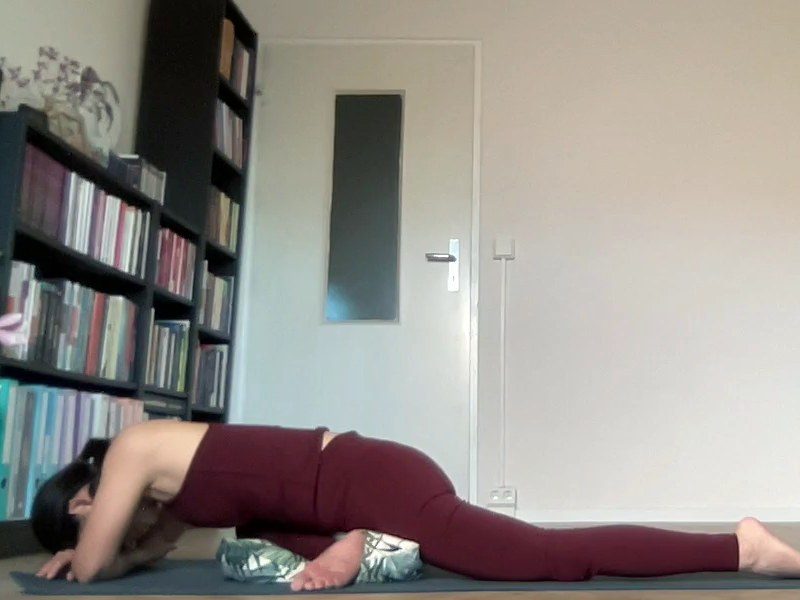
Pigeon, 5 minutesA cushion under the shin. In minute three, the leg starts to go numb. 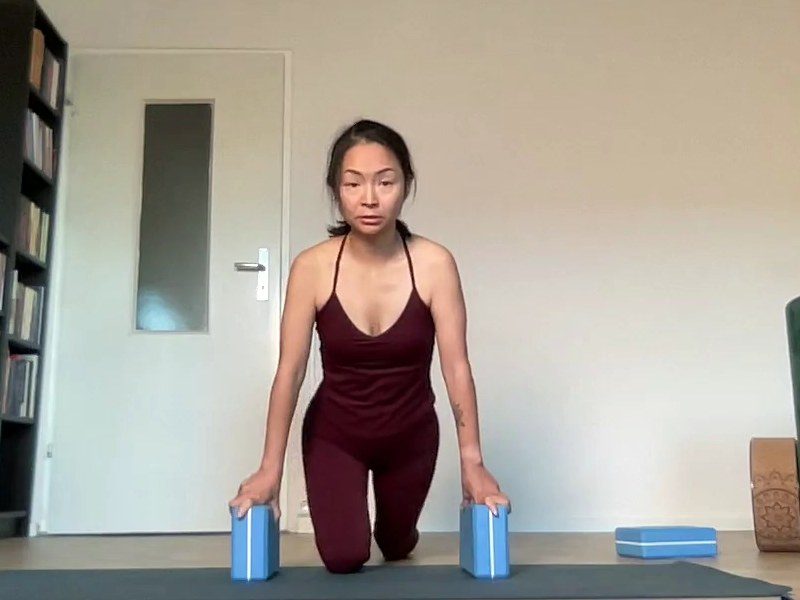
Going into the splitsBoth knees on the mat, hands on tall blocks. 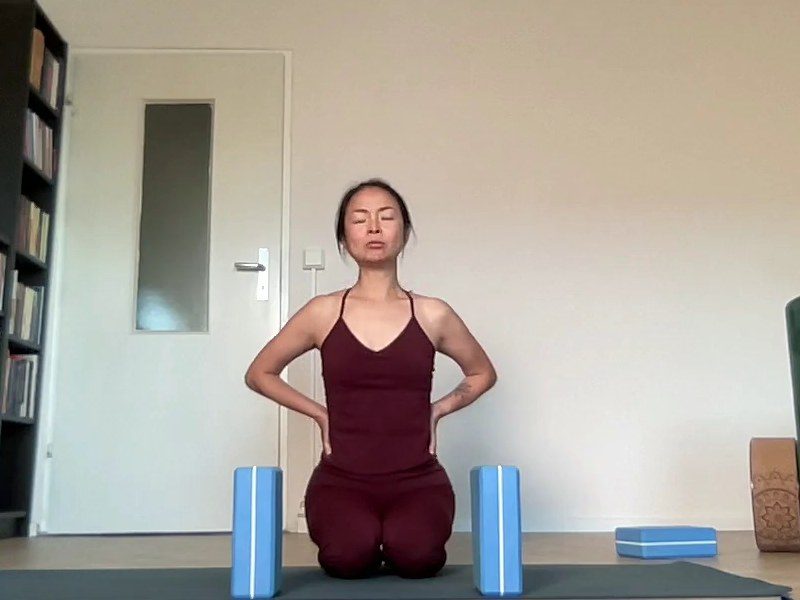
Between two roundsTalking about why the arms and shoulders keep gripping.
Photos from the class. They only show the pose at that moment. They don’t prove right or wrong, or whether the tightness went away.
1“Tight, tight, tight”: ask again, then add support
If you didn’t hear it clearly, ask again.
I asked “A little what?” twice before I heard “tight”. Then I said it straight away: I forgot to tell her to put blocks under her elbows.
I didn’t defend my first cue. I gave another option: fold the arms, rest the forehead.
Read what is said in the clip
- Giang: Does it feel tight? A little what? A little what?
- Student: Tight, tight, tight.
- Giang: A little tight, right? You can rest your elbows down. I forgot to tell you to get two blocks to cushion your elbows. There. Press your left groin down a little. Yes, that’s right. You can fold your arms and lower your forehead onto them. Yes. Put your arms under your forehead to ease the tension.
2“My legs are going numb”: change now, don’t wait for the timer
I gave five minutes. Her legs spoke up in minute three.
I didn’t say “just finish it”. We changed.
Five minutes is a direction, not a contest. Tight but still breathing evenly: you can stay. Numb: change.
Read what is said in the clip
- Giang: Stay in that position for five minutes. Just be as you are.
- Student: My legs are starting to feel numb.
- Giang: Okay, change position now. That was three minutes.
- Student: My legs started feeling numb, my lower legs, and then my legs started stiffening up.
Try one answer before clip 3
B is practising the splits on blocks. B says: “A little further and it’s very tight.” (A practice example, not the words of a real student.)
3“Like this, right?”: fix placement first, depth later
Too tight? Lift the hips. Don’t tip forward.
When it’s tight, people often throw the body forward to ease it. It looks deeper, but the hips go crooked.
I had her stand the blocks tall and move them back. A little higher, but straight.
Read what is said in the clip
- Student: Like this, right?
- Giang: No, keep them on the mat. On the mat. Keep both knees on the mat, as before. Keep your back knee firmly there, leave it there. Then step your right foot forward. Step your right foot forward. Don’t let your hips shift. Don’t lean your body forward, you’re leaning forward too much. Stand the block on its tall side. Move your body back. Move the block back, move both blocks back. If it feels too tight, lift your hips higher, don’t tip your body forward.
4“Very tight”: no need to go lower
How long you can hold matters more than how deep you go.
Her shoulders grip because her legs aren’t strong enough yet, so her arms hold her up. That takes time to build. No need to push further today.
Read what is said in the clip
- Giang: Tight, right?
- Student: Very tight.
- Giang: If you can’t bear it, pull back straight away.
- Student: A little further feels very tight.
- Giang: You don’t need to force it. What matters is how long you can hold it.
- Student: My arms are too tense, my shoulders are too tense. I can’t relax my shoulders.
- Giang: For you to relax your shoulders, your legs have to be very strong. Because you use your arms for support, you have to tense them.
When a student speaks up: 4 answers
- Didn’t hear clearly → ask again: “A little what?”
- Tight → add support, change what they lean on.
- Numb → change the pose, don’t wait for the timer.
- Very tight → stay here, lift the hips. Don’t go lower.
Sharp pain, numbness that spreads, or dizziness: stop completely. If someone has a medical condition, is pregnant or has had recent surgery, they should ask a health professional first.
Learning to teach is learning from moments like these
Four clips are a few minutes of one class. The whole class is asking, listening, changing, then asking again.
In the 200-hour online yoga teacher training, you practise leading on Zoom, I watch, and we look together at what to change. Reading teaches you what. Teaching a class is how it becomes yours.
Right first. Deep later.
Sources and limits
The four clips come from one of Giang’s online 1:1 yoga classes in October 2026. The class was in Vietnamese; subtitles were machine-transcribed, checked several times and translated into English, and unclear lines were cut. Clip 2 joins two moments about three minutes apart, marked “3 minutes later”; clips 3 and 4 skip a middle part. B and the answers are practice examples for learning to teach. This is not a home-practice plan and not medical advice.

Giang Hoang
Yoga teacher, E-RYT 500 & YACEP (Yoga Alliance)
Giang Metta Academy: RYS 200 & RYS 500 (YA ID 442630)
Based in Da Lat, Vietnam. Teaching online worldwide.