300-Hour Online Restorative Yoga Teacher Training
Props Engineering & Trauma-Informed Somatics specialization. Master restorative sequencing, zero-gap props arrangement, polyvagal nerve regulation, and practical case studies.
This course follows the same curriculum, learning outcomes and assessment requirements online and in person in Da Lat. Teaching delivery, schedules and tuition depend on the format. Explore the other format.

How the 300 Hours Are Structured
- 01. 120H in-depth training with Giang Hoang: functional anatomy of the spine, neck and shoulders and knees, and personalised restorative adjustments.
- 02. 90H mentoring and practical case study analysis: you find the people you guide (family, friends or your own students), with Giang mentoring you live on Zoom; together you review their practice records and build safe, adaptive practice plans.
- 03. 60H advanced topics: Yin Yoga, in-depth Pranayama, advanced functional anatomy and multi-layer alignment.
- 04. 30H assessment and RYT 500 upgrade: the 300H can be used together with a 200H foundation toward Yoga Alliance RYT 500 requirements, subject to current conditions.
The same 300-hour structure applies to the in-person training at the Giang Metta studio in Da Lat.
See what a 300H online class teaches
Articles from the 300H online class, with real clips and Vietnamese and English subtitles.
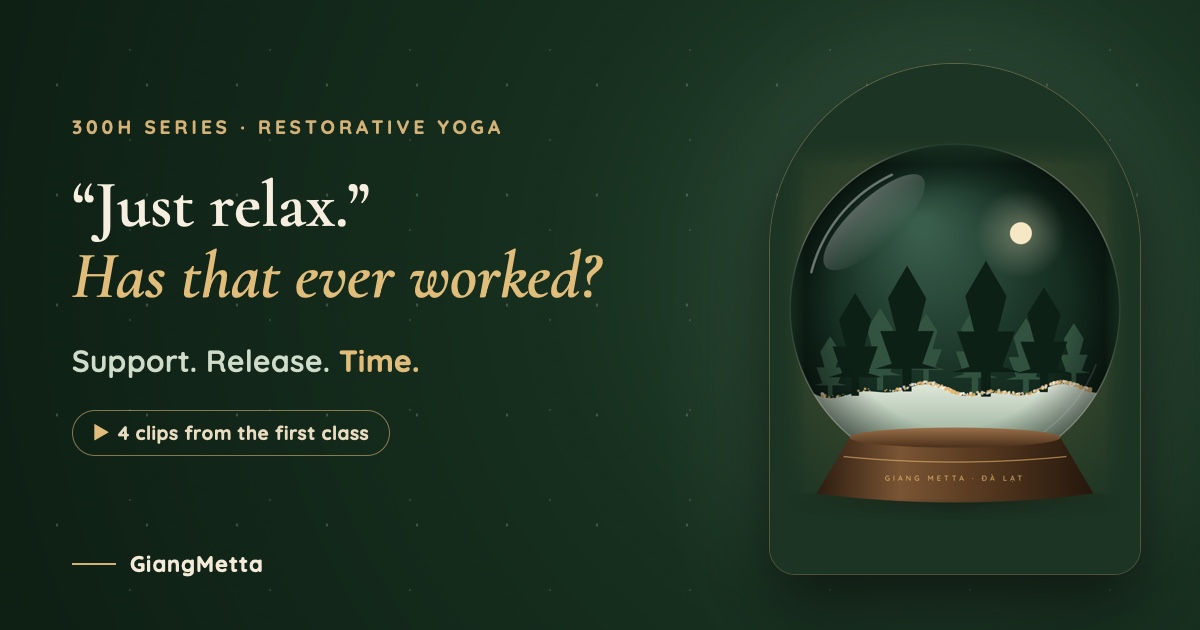 “Just relax.” Has that ever helped anyone relax?
4 clips from the first class: listening early, the window of tolerance, the snow globe, and why letting go needs support.
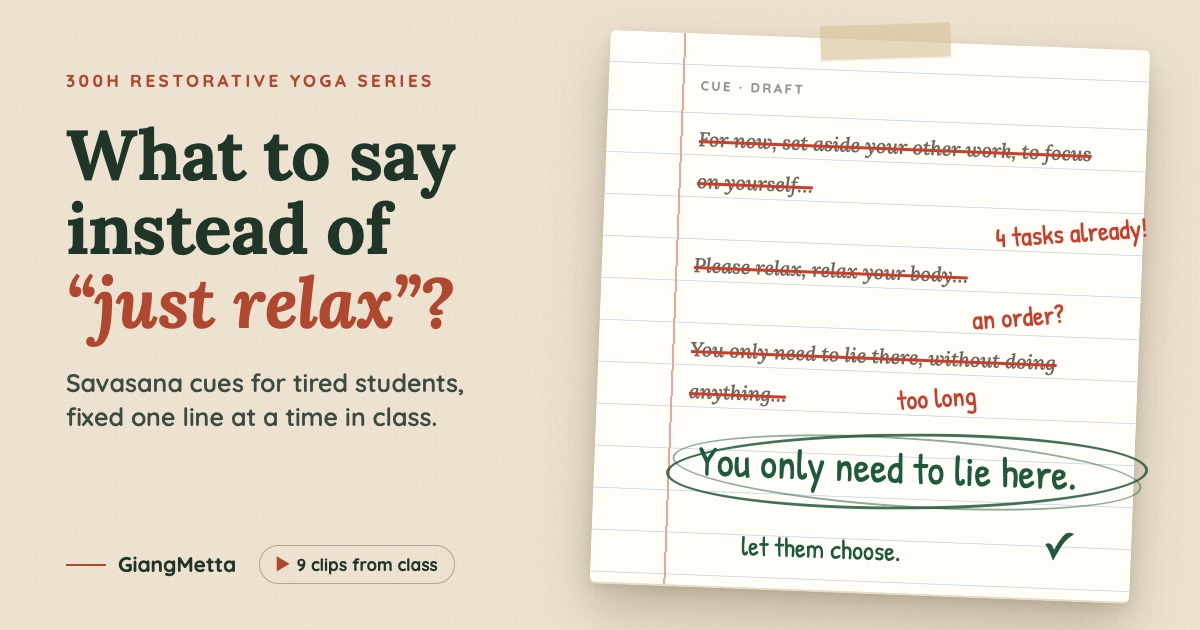 Savasana cues for tired students: what to say instead of “just relax”
9 clips: asking from the outside in, everyday words, a choice instead of an order, and saying little during Savasana.
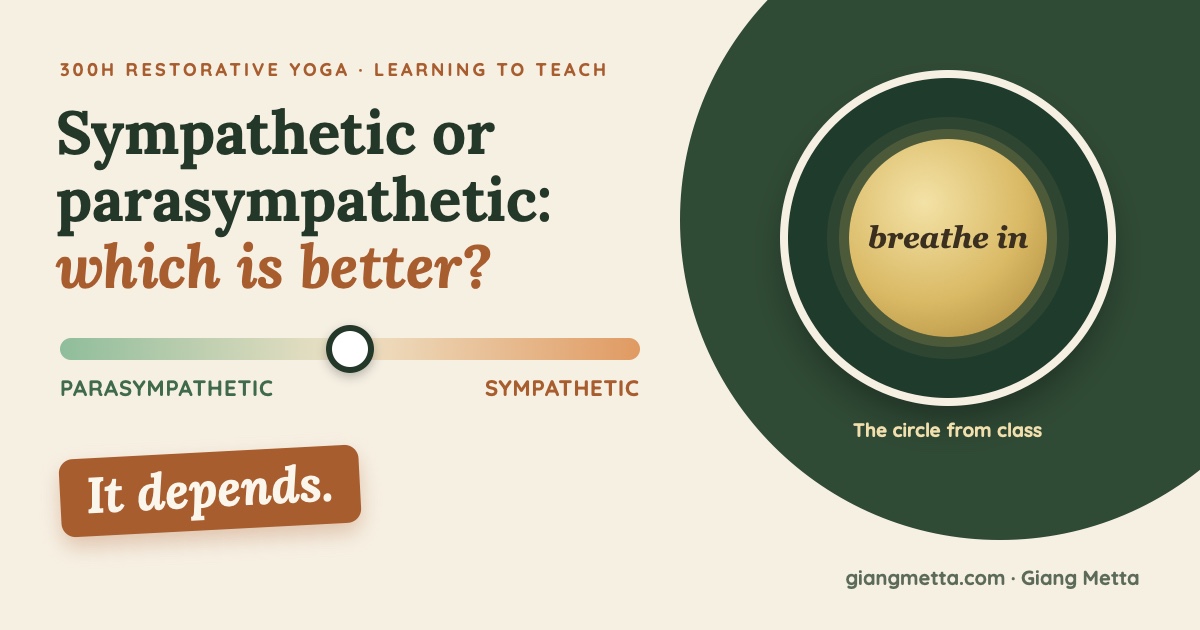 Sympathetic vs parasympathetic: which is better?
Neither system is good or bad. A two-round breathing test from class, a rubric for re-teaching, and the limits of a yoga teacher.
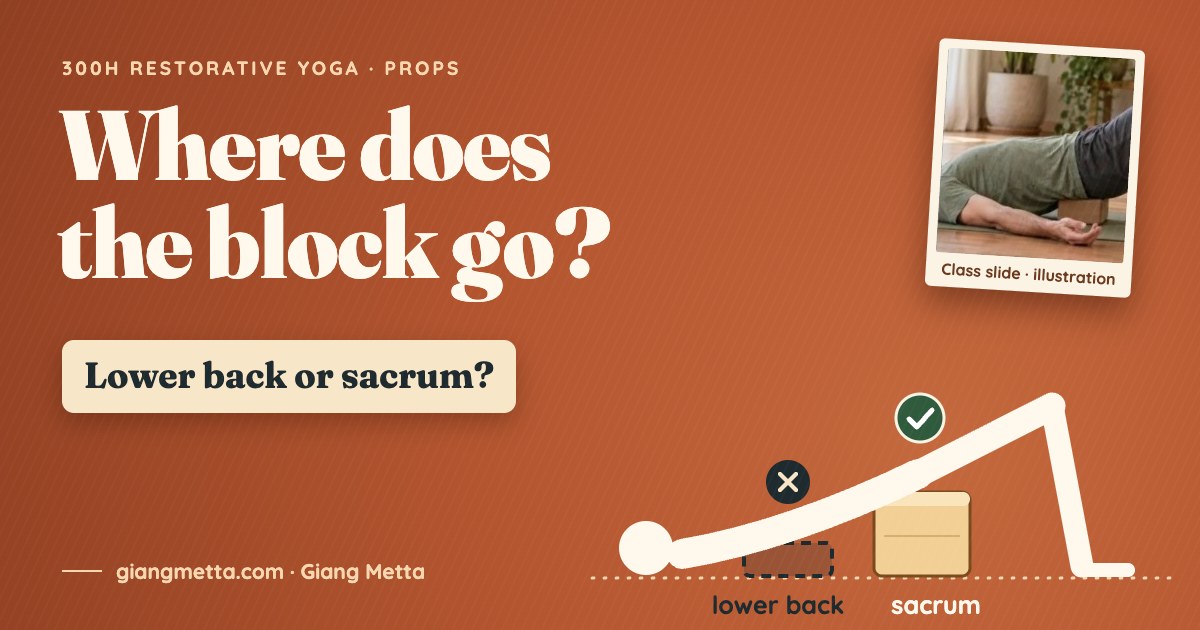 Block under the lower back or the sacrum? Six jobs for restorative yoga props
Module 2: read the gaps first, then choose props. Six verbs, the supported bridge, and why you practise a sequence before you teach it.
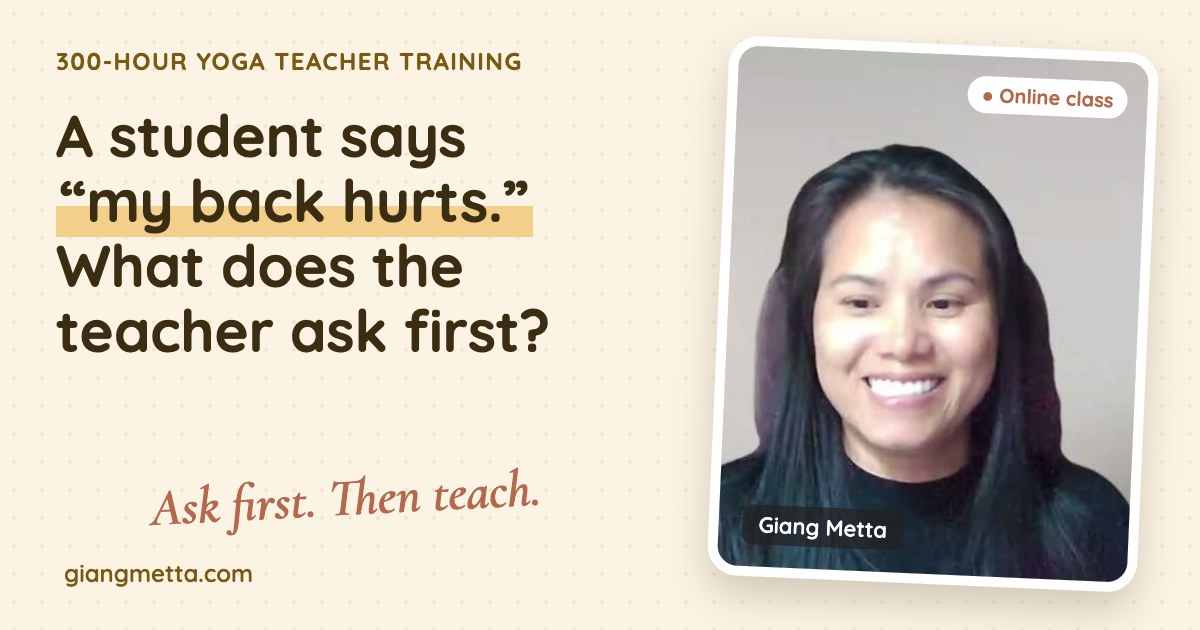 A student says “my back hurts”: what does a yoga teacher ask before teaching?
Four clips: three questions before you teach, props that take the load, the SI joint, and four signs to stop at once.
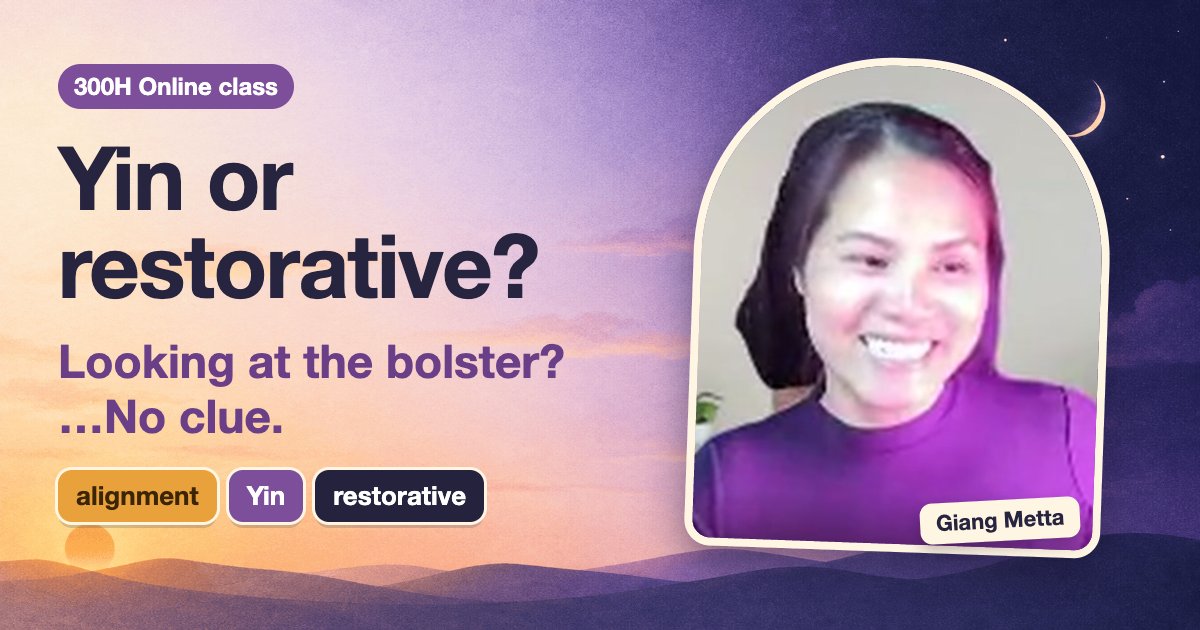 Yin vs restorative yoga: what’s the difference when both use a bolster?
Three clips: the same bolster, so watch how much effort the student is still making.
Detailed Curriculum — 6 In-Depth Restorative Modules
Advanced 300-hour restorative specialization for teachers with a 200H foundation, focused on Props Engineering and non-medical wellness boundaries.
Scientific mechanisms of the autonomic nervous system down-regulation:
- Autonomic Nervous System (ANS) Biology: Deep physiological shift from sympathetic dominance (Fight/Flight/Freeze) to ventral vagal parasympathetic state (Rest/Digest/Restore).
- Stephen Porges’ Polyvagal Theory in Practice: Biological signals of safety (Neuroception), mapping heart rate variability (HRV), and long-exhale and gentle-sound practices that invite a ventral vagal sense of safety.
- Window of Tolerance & Somatics: Recognizing hyper-arousal and hypo-arousal states; applying somatic grounding, pendulation, and self-regulation techniques.
- Zero Muscular Effort Mechanics: Eliminating isometric holding to initiate neuromuscular unwinding.
Art and structural engineering of zero joint hanging:
- The Zero Gap Principle: Completely supporting every physical contour (neck, lumbar curve, knee crease, ankles) so the skeletal system is 100% held by gravity and props.
- Fascial Anatomy & Fluid Dynamics: Viscoelastic properties of fascia, cellular hydration (piezoelectricity), and how long static holds (8–20 minutes) are thought to influence connective tissue.
- 10 Core Restorative Poses & Layered Variations: Supported Child's Pose, Supported Bridge, Supported Supta Baddha Konasana, Legs up the Wall (Viparita Karani) and more.
- Joint Safety in Depth: Protecting joint capsules, menisci and ligaments; telling the difference between releasing tissue tension and overloading a joint.
- Mastery of Professional Restorative Setups: Mountain Brook setup, Queen Posture (Supta Baddha Konasana with chest expansion), supported bridge, and pelvic tilts.
- Precision Micro-Adjustments: Folding weighted Mexican blankets, contouring eye pillows, sandbag placement for proprioceptive anchoring without sensory overload.
Psychological safety, invitational language, and strict ethical scope:
- Invitational & Inquiry-Based Language: Replacing rigid commands with invitational verbal choices ("I invite you to...", "Notice if it feels comfortable to..."), empowering student agency.
- Strict Non-Medical Ethical Boundaries: Upholding the clear distinction of Yoga as non-medical wellness; zero medical pathology diagnosis, knowing red flags and medical referral pathways.
- Trauma Triggers & Safety Protocols: Recognizing silent signs of dissociation, flash freezing, or emotional releases; applying somatic grounding, sensory anchoring, and respectful de-escalation.
- Studio Atmosphere & Sensory Sanitation: Setting ambient warm lighting, dimming glare, eliminating aggressive fragrances, and providing physical security in the room layout.
Energetic meridians and rebound integration (Traditional Chinese Medicine view):
- 12 Principal Meridians in Restorative Yin: Mapping Kidneys & Urinary Bladder (vitality/fear balance), Liver & Gallbladder (flexibility/anger), Spleen & Stomach (centering).
- Five Element Theory (Wu Xing): Water, Wood, Fire, Earth, and Metal associations with circadian seasons, emotional tendencies, and restorative pacing.
- The Sacred Rebound State: The vital transition period between restorative postures for noticing sensation and integrating the practice.
- Combining Yin & Restorative: Integrating gentle static Yin stretches with fully supported Restorative postures.
30 practical lesson plans of 60–90 minutes, arranged in three groups:
- Group 1 — Musculoskeletal System & Spine: Neck and shoulders (plan 1), lower back (3), shoulder mobility and shoulder blades (7), sciatic-area and piriformis support (11), knee stability (12), and supported whole-spine rest (27).
- Group 2 — Nervous System & Emotions: Rest and sleep (4), anxiety-related relaxation (15), burnout recovery practices (16), relaxation to support sleep (17), Somatics and emotional awareness (18), and Yoga Nidra (29).
- Group 3 — Traditional Organ-System Framework & Specific Needs: Hips and psoas (2), gentle spinal twists (5), chest opening and breathing (6), comfort during hormonal changes (20), postnatal pelvic-floor and core practice (21), and digestive comfort (26).
Professional mentorship, practical case studies, and full teaching assets:
- Multi-layered Krama Sequencing: Designing personalised 1:1 restorative programs and specialised workshops for busy people.
- 2 Practical Case Studies: Working with 2 individual subjects across 5–8 customized 1:1 restorative sessions with detailed documentation and supervision from Giang.
- Senior Mentoring Pedagogy: Conducting observational assessments, offering compassionate teacher feedback, and coaching next-generation yoga teachers.
- Turnkey 93-Slide PPTX Deck: Original widescreen deck in a 3-slide A-B-C structure with no repeated poses, illustrated entirely with photos of real people, plus props layouts and teacher notes. Ready for your own classes and workshops.
- Lifetime course videos: Close-up demonstrations of body placement, teaching cues, props and posture adjustments. Yours to keep for life.
- Yoga Alliance RYT 500 Credentialing: Prepare your training portfolio. RYT 500 registration is a separate application with Yoga Alliance, subject to its training and teaching-experience requirements.
Private 1:1: 44.500.000₫ (no Early Bird discount)
Certificate of Completion issued by Giang Metta Academy. The 300H course may be combined with prior 200H training for a separate RYT 500 application, subject to Yoga Alliance requirements, including teaching experience.
💳 International Payment Note: All tuition fees are listed and charged in Vietnamese Dong (VND). After your enquiry, Giang confirms the payment details with you directly; for international transfers, your bank applies its own exchange rate and fees.