30H · Foundation
IPHM-Accredited Program (UK)
In Person + PPTX/Video
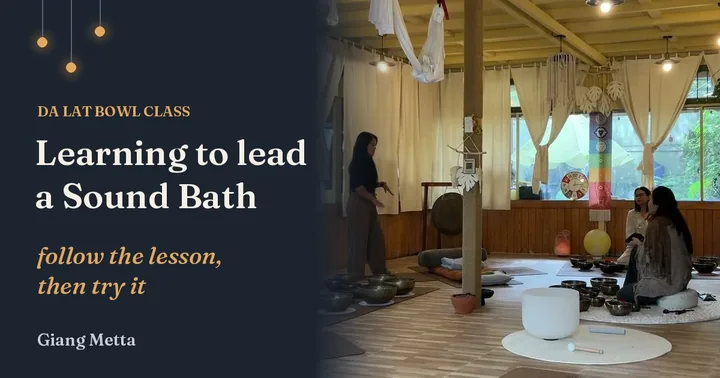
30-Hour Sound Healing Training — In Person in Da Lat
20 hourswith Giang in Da Lat
10 hoursguided practice
For beginners. 3 days in person with Giang Hoang in Da Lat.
Choose 1 type of bowl · same price, same schedule
A · Tibetan singing bowlsMetal alloy, deep and warm. Can be placed on the body when the person agrees.
B · Crystal singing bowlsQuartz, one main note. A clear sound that rings for a long time.
The 4-part path
- Part 1 Sound foundations and choosing your bowl
- Part 2 Bowl technique and basic Gong
- Part 3 Leading a Sound Bath in 5 stages
- Part 4 Safety, screening and a non-medical scope
PPTX slides and video materials with lifetime access. The Certificate of Completion is issued by Giang Metta Academy; the program is accredited by IPHM.
See the 4 parts in detail (Tibetan · Crystal)
Option A: Tibetan singing bowls
Tibetan (Himalayan) singing bowls are made from a metal alloy and have a deep, warm resonance. They can be placed on the body when the person agrees.
- Part 1 · Foundations: the origins of Tibetan singing bowls and how to identify them, and their copper–tin alloy; choosing a bowl by ear, eye and hand; frequency, overtones and why the sound of a bowl pulses; deep listening and telling frequency ranges apart.
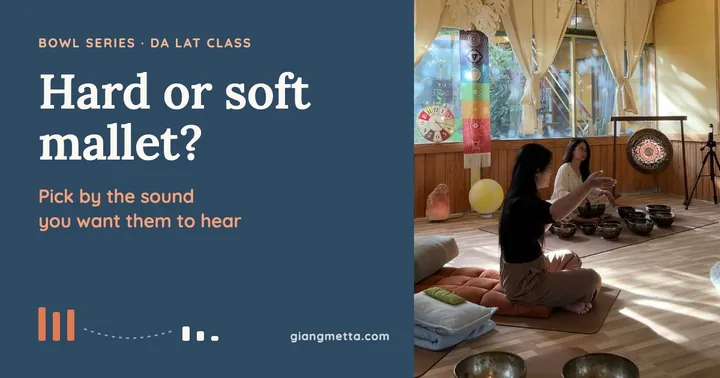
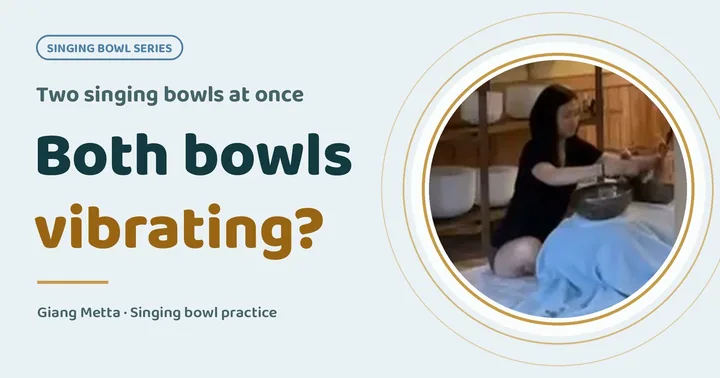
- Part 2 · Technique: holding the mallet, supporting the bowl and the angle of contact; striking with a touch-and-release, choosing a soft or hard mallet for the tone; playing the rim for an even sound and fixing rattling; controlling volume for a clean sound; placing bowls on the body in 4 steps: ask, place, strike gently, ask again; arranging bowls around a person lying down, never passing a bowl over the face; basic Gong technique.
- Part 3 · Facilitation: guiding a session in 5 stages: welcome, settling, immersion, quieting, return; transitions and linking the sounds of different bowls; the guiding voice and silence.
- Part 4 · Safety: volume, distance and duration; pre-session screening and the cases that need caution (pregnancy, implanted heart devices, a history of seizures); consent and the right to stop; responding if something goes wrong; professional ethics and a non-medical scope of practice.
Option B: Crystal singing bowls
Crystal singing bowls are made from quartz. Each bowl usually gives one main note, with a clear sound that sustains for a long time.
- Part 1 · Tone and choosing a bowl: understand the pitch, overtones, sustain and intensity of crystal singing bowls; read the size, note and material specifications when choosing a bowl.
- Part 2 · Bowl and Gong technique: choose the right mallet (silicone, suede or rubber); strike and play the rim, adjusting striking force and rim speed for a smooth sound with no harshness or rattling; control volume and distance from the listener; combine several bowls tuned to different notes; basic Gong technique.
- Part 3 · Guiding a Sound Bath: guide a session in 5 stages: preparing the room, linking the sounds of different bowls, the guiding voice, quiet space and closing; build a sound journey and arrange the listening space for 1:1 sessions and group Sound Baths.
- Part 4 · Safety and care: manage volume and listening time; run a screening consultation before each session; respect the listener’s right to stop and the non-medical scope of the session; store and transport crystal bowls safely to prevent cracks and breakage.