Cobra vs Upward-Facing Dog: How Do You Tell Them Apart?
In the middle of an online lesson, I asked my student: can you turn the camera a little towards your feet?
The camera was pointing at her head. I could see her chest and her shoulders. Not her legs.
“A bit more.” “More.” “OK, stop.” Teaching online, I have become quite a good camera operator.
She had just finished her first round of upward-facing dog. From the head end, that pose looks a lot like cobra. The difference is lower down, outside the frame.
She is training to teach. One day her students will mix up these two poses too. Let's see if you do.
Guess before you read on
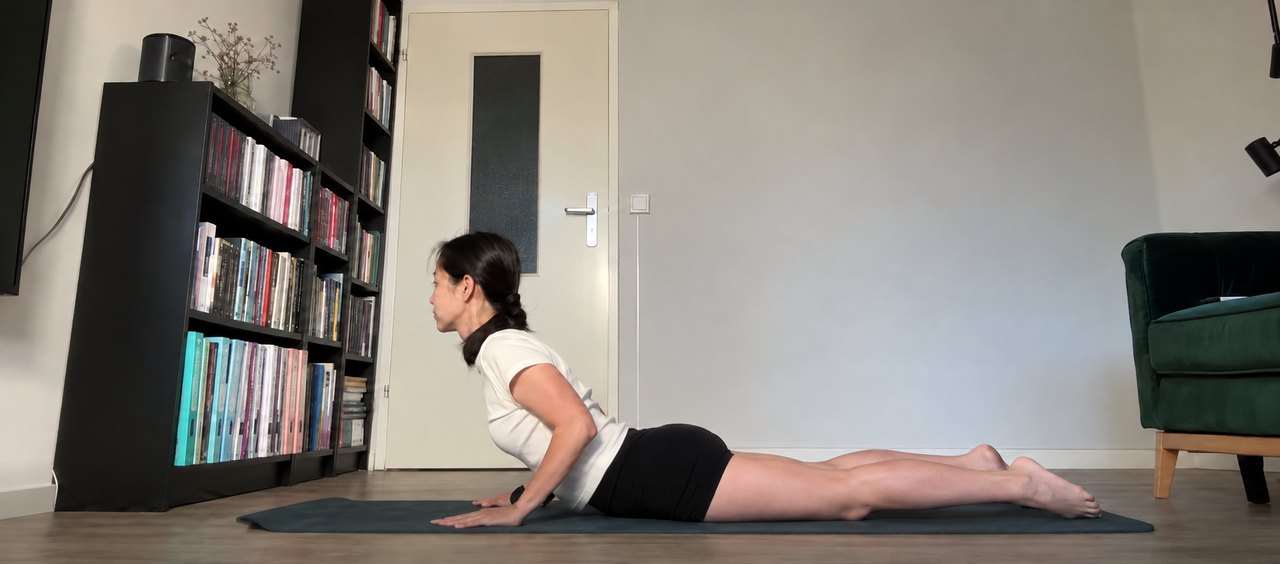
Which pose is she in?
Right. Look below the chest: her pelvis and both legs are still on the mat, and her elbows are still bent. That is cobra.
Not quite. Her chest is quite high, but look lower: her pelvis and both legs are still on the mat, and her elbows are bent. That is cobra. In upward-facing dog, the pelvis and thighs leave the floor.
That is the whole trick of this article: don't watch the chest, watch what touches the floor.
Cobra · Bhujangasana
Pelvis on the floor. Legs stay down.
Elbows bent. The chest lifts as far as is comfortable.
Upward-facing dog · Urdhva Mukha Svanasana
Pelvis off the floor. The thighs too.
Arms almost straight. Only the hands and the tops of the feet touch.
The yellow dot is the pelvis. On the floor: cobra. Off the floor: upward-facing dog.
Reading this to practise? Go straight to how to do cobra. Training to teach? There is a 30-second cue card and a camera set-up near the end.
In short
- Look at three places: pelvis, elbows, legs. Cobra: pelvis on the floor, elbows bent. Upward-facing dog: arms almost straight, pelvis and thighs off the floor. Don't judge by how high the chest is.
- Upward-facing dog is harder. Beginners learn cobra first, slowly, step by step.
- Stop if you feel pain, numbness or dizziness. Don't wait for sharp pain. If you have a spine condition, ask your doctor first.
In this article
- Why are these two poses so easy to mix up?
- Cobra vs upward-facing dog: what are the three differences?
- Cobra: how many cues does a beginner need?
- Three common misunderstandings
- Upward-facing dog: why is it harder?
- “Hips to the floor” or “hips don't touch”?
- Try it now: which pose are you in?
- When should you ease off or stop?
- A 30-second cue card for trainee teachers
- Teaching online: where should the camera go?
- Questions people often ask
Why are these two poses so easy to mix up?
Both start lying on your belly. In both, your hands are near your chest, your chest lifts and your back bends backwards.
The names are confusing too. Upward-facing dog is not downward-facing dog (Adho Mukha Svanasana). Downward dog pushes the hips up high into an upside-down V. It is not a backbend. This article is only about the first two.
In that lesson, while I was teaching cobra, I had already warned her: when you teach, you'll see how easily students mix these two up.
Cobra vs upward-facing dog: what are the three differences?
Go back to the photo you just guessed. This time it is numbered, in the order I usually look when I teach.
Three places to look in cobra
- PelvisCobra: on the floor. Upward-facing dog: the whole pelvis lifts.
- ElbowsCobra: soft and bent, shoulder blades rolling back and open. Upward-facing dog: almost straight, with only a soft bend so you don't lock the joint.
- LegsCobra: stretched out, resting on the floor. Upward-facing dog: off the floor, only the tops of the feet press down.
With bent elbows, the body doesn't come up very high. That is normal in cobra. It doesn't mean you are doing it badly.
It is also how I observe a yoga pose, starting from what touches the floor, in general.
Cobra: how many cues does a beginner need?
Five.
- Lie on your belly. Stretch your toes back.
- Place both palms beside your chest.
- Point your elbows up to the sky.
- Slowly use your arms to lift your upper body a little.
- Keep your pelvis on the floor.
Then I told her: just say that. People understand bit by bit. Where something is off, you correct it, little by little.
When a beginner hears ten instructions at once, they tense up. And when they are tense, everything gets harder.
One more cue I often add: the neck follows the back. If your back doesn't bend much yet, don't tip your head back much either.
Three common misunderstandings
She asked me the first two during the lesson.
Sounds right, but it isn't
1. “So the weight goes into my hands?”Not quite
She asked almost exactly that. The work is in both the arms and the back. The back muscles do the main work. They engage as you lift.
2. “Breathe out as you lift.”Wrong way round
In my class, you breathe in as you lift and lengthen up. If you are new and can't match breath and movement yet, breathe normally. Just don't hold your breath. I write more about this in how to breathe in yoga.
3. “The higher the chest, the better.”Misunderstanding
A high chest doesn't make it upward-facing dog. A low chest doesn't make it cobra. In cobra, bent elbows and a comfortable lift are correct. What touches the floor tells you the pose.
Upward-facing dog: why is it harder?
Before she tried it, I told her: this pose is heavy. Take it one step at a time.
It is heavier because your pelvis and legs are no longer on the floor. Your whole body is held up by almost-straight arms and the tops of your feet. In cobra, the floor carries part of you.
On her first round, she lifted her body and legs. I adjusted her hands, asked her to lift her head a little and open her shoulder blades back, then let her rest. This is how I led her in the second time:
- Lie on your belly, tops of the feet flat on the mat.
- Place your hands lower, near the bottom of your chest. I told her to watch her thumbs: roughly level with the lower chest.
- Take a deep breath in, then slowly lift up.
- Press the tops of your feet firmly down. Legs off the floor.
- Hips point towards the mat, but don't touch it.
- Tip your head back slightly.
Learn upward-facing dog once cobra feels comfortable, ideally with a teacher watching. If your arms get tired or shake, come down and rest. I gave her a short rest between the two rounds.
- HandsNear the bottom of the chest. Thumbs roughly level with the lower chest.
- ArmsAlmost straight, with a soft bend so you don't lock the joint.
- Tops of the feetPress firmly into the mat.
- Thighs and kneesOff the floor.
- HipsTowards the mat, but not touching.
- HeadTipped back slightly. The neck follows the back.
“Hips to the floor” or “hips don't touch”?
On her first round, I told her to let her hip bones “sink to the floor a little”. I also said her hands were a bit too far forward, which made it hard to lower her hips, and asked her to bring them back towards the lower chest.
On the second round, I said it clearly: legs off the floor, hips towards the mat, but not touching.
Cue while correcting“Sink to the floor a little.”
The goal“Hips towards the mat, not touching.”
Read on its own, “sink to the floor” is easy to misread as hips resting on the floor. The second cue is the real goal: hips towards the mat, not touching.
That was a correction for one person in one round. It doesn't mean you should force your hips or lower back down. If your lower back feels pinched, come down.
When you teach: a correction in the middle of a pose, heard on its own, can point to the wrong goal. After correcting, say the goal again clearly.
Try it now: which pose are you in?
If you are used to lifting your chest while lying on your belly, and your back doesn't hurt, try one low cobra. Stop where you can still breathe easily, then ask yourself three questions:
- Is my pelvis still on the floor?
- Are my elbows still bent?
- Is my neck bending back more than my back?
Try it, then choose what you notice
How did you answer those three questions?
Yes, yes, no: you are in cobra. Lift as far as is comfortable. It doesn't need to be high.
Pelvis lifted, arms straight: you are leaving cobra. That is not upward-facing dog yet: in that pose, the thighs and knees also leave the floor, and only the hands and the tops of the feet touch. If you haven't learned it with a teacher, come back down. Don't push higher.
Neck bending back more than your back: the neck follows the back. If your back isn't bending much, don't tip your head back much either. Lower your chin a little.
Pain, numbness or dizziness: come down and stop this round. See when to ease off or stop.
This is self-observation, not a diagnosis.
When should you ease off or stop?
In that lesson, she said even holding cobra made her arms ache. I told her there is no need to rush through the basic poses. On tired days, do a little less. On strong days, do more.
Yoga is not about wearing yourself out.
Ease off
Your arms shake, you are breathing fast, or you have to tense your neck and face to stay up. Go back to a low cobra, or lie down and rest.
Stop
Pain in your back, neck, shoulders or wrists; numbness or pain that spreads; dizziness. Don't wait for sharp pain. If the pain doesn't go away or keeps coming back, see a doctor.
Ask a professional first
Long-term back pain, a spine condition, pregnancy, or recent surgery. I can't diagnose anything through an article.
A 30-second cue card for trainee teachers
Your students won't tell you: “I'm doing upward-facing dog, but my pelvis is still on the floor.” You have to see it.
To see it, you need to know where the difference is, and be able to say it in short sentences. Screenshot this card if it helps:
Cobra
1. Lie on your belly, toes stretched back.
2. Palms beside the chest.
3. Elbows point up.
4. Breathe in, lift the upper body a little.
5. The pelvis stays on the floor.
Upward-facing dog
1. Lie on your belly, tops of the feet flat.
2. Hands near the lower chest, thumbs level with it.
3. Breathe in deeply, lift slowly.
4. Press the tops of the feet. Legs off the floor.
5. Hips towards the mat, not touching. Head back slightly.
I told her: practise, and learn the names and the steps as you go. Next lesson, we would go through them again.
In my 200-hour online yoga teacher training, I teach each pose like this: practise it, tell it apart, then practise leading it for someone else. After you graduate, you still have to stand in front of a class and build experience yourself. Nobody can do the looking for you.
Teaching online: where should the camera go?
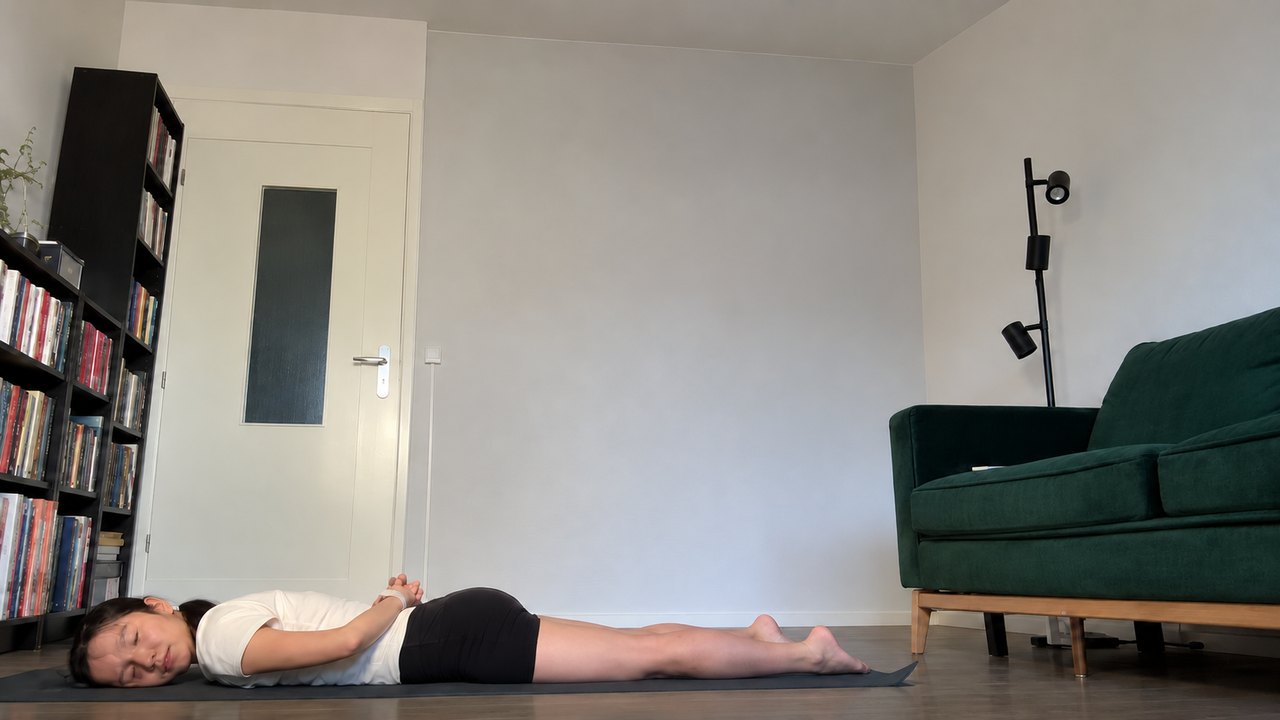
In a studio, the teacher walks round to the side to look. Online, I only see what the camera shows me. So teaching online needs one more skill: knowing how to ask a student to move the camera, and to the right place.
In her first round of upward-facing dog, the camera was aimed mostly at her head. I could see her chest and shoulders, but not her legs. And the legs decide the pose.
So while she rested, I asked her to change the angle before she tried again.
- Angle it towards the feet. No need to bring the camera closer.
- Show the whole body, from head to feet.
- Adjust a little at a time. When the teacher says “more, more, OK”, you are done.
Before belly-down poses: place the camera to one side of you, far enough away to show your whole body, then ask your teacher if they can see your feet.
Questions people often ask
Does your belly button have to touch the floor in cobra?
Not necessarily. What matters is that the pelvis stays on the floor. In that lesson, I asked her to lift her navel slightly, but you don't need to push up just to get your navel off the mat. Some schools teach the navel on the floor. That is fine too.
What if my thighs stay on the floor in upward-facing dog?
If your thighs and pelvis are on the floor, you are closer to cobra. In the upward-facing dog I teach, the legs lift off the floor and only the tops of the feet press down. If you are not strong enough yet, keep practising cobra. There is no rush.
Do you breathe in or out as you lift?
In my class, you breathe in as you lift. If you are new and can't match the breath yet, breathe normally. Don't hold your breath.
What is the difference between upward-facing dog and downward-facing dog?
Upward-facing dog: chest lifted, back bending, looking forward. Downward-facing dog: hips pushed up high, body in an upside-down V, head down. They belong to different groups of poses.
Which one is used in Sun Salutation?
In the sequence I lead in Sun Salutation for beginners, this step is cobra. Some classes use upward-facing dog in the same place. For beginners, I choose cobra.
Last words
The two poses look alike at the top. They differ at the bottom.
So before I correct anything, I look at what touches the floor. Online, I ask for the camera to turn first.
Look at the feet first.
Read more
- How to observe and adjust a student's yoga pose
- How to cue yoga poses so beginners can follow
- Sun Salutation for beginners
- How to breathe in yoga
- Locust vs bow pose: what's the difference?
- Can't do wheel pose yet? What to practise first

Giang Hoang
Yoga teacher, E-RYT 500 & YACEP (Yoga Alliance)
Giang Metta Academy: RYS 200 & RYS 500 (YA ID 442630)
Based in Da Lat, Vietnam. Teaching online worldwide.