Learning to guide singing bowl practice · Article 03
Singing bowls for someone lying down: watch their face
That evening I taught a 1:1 singing bowl class in English, for a learner from abroad. A friend lay under a blanket as the receiver. Bowls all around her, a few right on the blanket.
The learner’s circles were already quite good. But the thing I wanted her to remember most was not in her hands:
stop staring at the bowl. Look at the person’s face too.
Five things to watch around the mat
Bowl1Point to remember (1–5)
Seen from above. The head is on the left.
1Stand where you can see their face
Watch: where the learner stands when I say “You should be here.”
Watch the face, not only the bowl.
Eyes on the bowl, your hands stay even. But is the person comfortable or not? You cannot tell. Before you play, find a place where you can see their face clearly.
Tap a moment to watch that part:
- “You should be here.”
- Why you need to see the face
- Learner: “She looks relaxed.”
- “Don’t look at your bowl only.”
Read the clip transcript
- Giang: You should be here, like this.
- Giang: Because you need to see her face.
- Giang: Look at her face: comfortable or not?
- Learner: She looks relaxed.
- Giang: Don’t look at your bowl only.
Your knees get tired mid-circle. What do you do?
You are kneeling next to the person. The bowl on the chest needs a few more circles, and your knees are starting to ache. (A practice scenario.)
2Knees tired? Stand up and circle
Watch: the learner stands and circles with the bowl at chest height.
Keep bending like that, and your back will hurt soon.
Bending in close looks hard-working. But when your knees are tired and you still bend, your back takes the load. Your hand loses strength too. Just stand up and hold the bowl at chest height. Your press gets steadier.
And on days the player is already tired before the session, I still tell learners: no circling today, just sit and strike.
Tap a moment to watch that part:
- Learner asks: can I bend in close?
- “No need if you’re tired.”
- Learner: “Only my knees are tired.”
- Stand higher, press better
Read the clip transcript
- Learner: If I’m rimming this one, can I go like this? Close to the heart.
- Giang: No need if you’re tired.
- Giang: If you’re tired, do like this.
- Giang: Like this is better. Like this is better.
- Learner: But only my knees are tired. My back is not.
- Giang: No, the back gets tired. It hurts later.
- Giang: When you do like this, no need.
- Giang: If you’re high like this, you can rim and press more.
3Tuck the blanket edge before you set the bowls
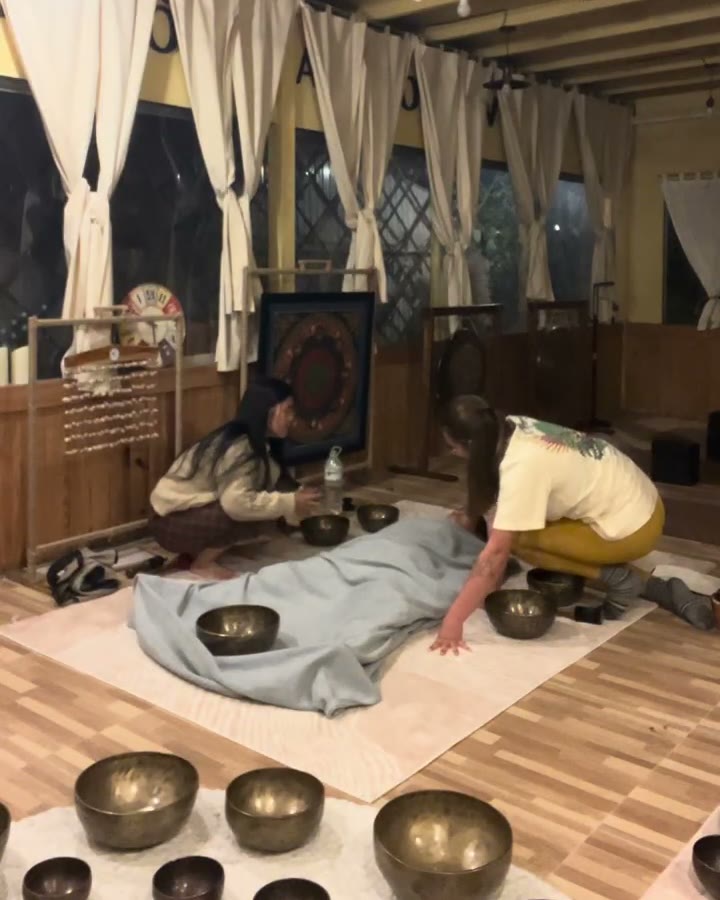
Before the first bowl goes down, I tuck the blanket edge close to the person.
They feel wrapped and settled. And a loose edge does not creep into the spot where the bowls go.
4Keep the bowls on the mat, with a path to walk
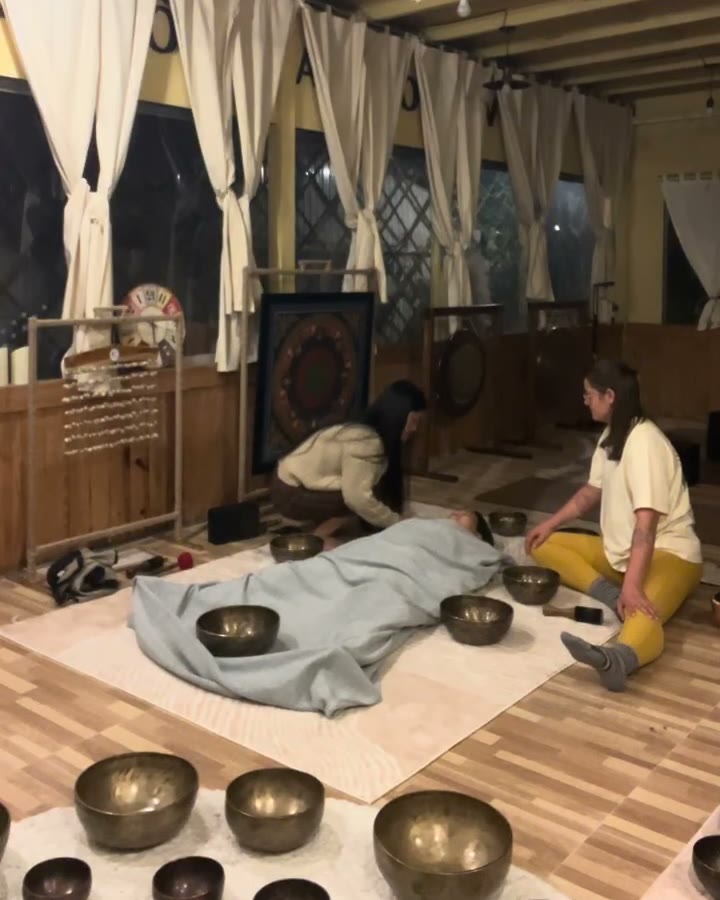
While we set the bowls, I showed her where to put them: all on the mat, with enough room left to walk around.
“Because if you walk here, no noise.”
Learner: “It doesn’t make sound.”
Step off onto the bare floor in the middle of a session and it clacks right away. So the bowls, the player and the path all stay on the mat.
5Lift your feet when you move
Near the end, the learner started shuffling her feet across the mat. I told her right away: don’t walk like that, lift your feet.
She laughed and said it felt like ballet. It does. The person lying down has their eyes closed. One small scrape of your foot and they hear it, loud and clear.
Relax yourself first
In another class, two learners sat practising their circles. I walked around and reminded each one: Softer. Slower.
Then: Relax your hands and your face. Breathe.
I also asked one of them: have you been holding your breath?
When the player is tense, the strike is stiff and the steps get heavy. You have to let go first. Then the person lying down can relax with you.
Practise these 5 points in groups of three
- Stand where you can see the face of the person lying down.
- Knees tired? Stand up and circle. Already tired before you start? Just sit and strike.
- Tuck the blanket edge close to the person.
- Keep the bowls and your path on the mat.
- Lift your feet when you move. Do not shuffle.
One person lies down, one plays, one watches. Each round, the observer gives just one reminder. Then swap roles. Placing bowls on a person is something to learn in person with a teacher first.
Why I teach bowls in person
None of these small things are about striking or circling technique. I have to stand right next to the learner and see how she stands, steps and bends. Only then can I correct it.
I often tell my learners: once you choose to be a trainer, find ways to make things easier yourself. Don’t just do what the teacher said and stop there. You have to think.
Remember to watch the face.
Common questions
Should I sit or stand when circling a bowl for someone lying down?
If sitting feels fine, sit. When your knees start to tire, or you have to bend low over the person, stand up and hold the bowl at chest height. On a tired day, just sit and strike.
Why look at the face of the person lying down?
Their face tells you if they are at ease or still tense. With your eyes glued to the bowl, your circles stay even, but you miss how the person is doing.
Can bowls be placed on the person?
In the clip, a few bowls sit on the blanket. Placing bowls on a person, which bowl and where, needs in-person learning with a teacher.
Whose words are the English subtitles?
Mine. This class was taught in English. My classroom English is all short, broken sentences, so the subtitles tidy them a little. The Vietnamese line on top is a translation. Yellow text is the learner.
Sources and further reading
The two clips and two photos come from one in-person 1:1 singing bowl class in Da Lat, taught in English. The “relax” and “you have to think” parts come from another class, taught in Vietnamese. The clip words were transcribed by machine and cross-checked in two passes; the subtitles are tidied. The practice scenario and group exercise were added for this article.
- Article 01: When should you strike a singing bowl again? — practise listening to the sound before giving feedback.
- Article 02: Singing bowl practice: make every circle count — count circles, both hands, steady bowls, sit at ease.
- In-person singing bowl training in Da Lat — learn hands-on, with someone watching and correcting you.

Giang Hoang
IPHM Certified Sound Healing Practitioner (UK)
Yoga teacher, E-RYT 500 & YACEP (Yoga Alliance)
Giang Metta Academy: IPHM Accredited Training Provider (No. IPHMNC22210) · RYS 200 & RYS 500 (YA ID 442630)
Based in Da Lat, Vietnam. Teaching online worldwide.