Singing bowls in Da Lat · Student review · 30 hours
After the 30-hour singing bowl course in Da Lat, who did Thanh use the bowls for?
Thanh had just finished 3 days of training. In a clip under one minute, she says who she used the bowls for: herself first, then her family, other people, and the studio’s clients.
Giang Metta · 0:58 clip · Vietnamese and English subtitles
Thanh sits on a white mat, in a pink top and glasses. Behind her is the studio’s bowl shelf.
She had just finished the 30-hour singing bowl course and sat down to share a few thoughts. Nothing was prepared, so the clip is under a minute.
Listening again, I counted the words Thanh used most:
Words Thanh used most (in English)
- “practise”2
- “clients”2
- “apply”2
- “thank you”3
Not one word about certificates. Thanh only talks about what she can do now, and for whom.
Read the full clip transcript (English · Vietnamese)
InterviewerThis is Tan Thanh.Đây là bạn Tân Thanh.
InterviewerShe took the 30-hour singing bowl course at Giang Metta.Bạn đã học khóa chuông xoay 30 giờ tại Giang Metta.
InterviewerCould you share a few thoughtsBây giờ xin bạn cho một vài cảm nhận
Interviewernow that you have finished the course?sau khi hoàn thành khóa học.
ThanhHi, I am Tan Thanh.Dạ, em là Tân Thanh.
ThanhI have just finished the 30-hour singing bowl course.Em vừa kết thúc khóa học 30 giờ về chuông xoay.
ThanhAfter the course, I feel very confidentSau khóa học, em rất là tự tin
Thanhto use everything my teacher taught međể mình có thể áp dụng tất cả kiến thức mà cô đã dạy
Thanhfor myself, for my family,cho bản thân, cho gia đình,
Thanhand for other people too.cũng như là có thể làm cho mọi người.
ThanhThe knowledge is really useful,Lượng kiến thức rất là bổ ích,
Thanhand there is a space where I can practise.và có một không gian để em có thể thực hành.
ThanhThe space here in Da Lat is so relaxing,Không gian ở tại Đà Lạt luôn thì rất là chill,
Thanhwith all the toolsvà đầy đủ các dụng cụ
Thanhto practise with clients right here.để em có thể thực hành cho khách hàng ở đây luôn.
ThanhThank you so much for giving me the chanceVà rất là cảm ơn cô đã tạo điều kiện
Thanhto work with real clientsđể em được áp dụng cho khách hàng thực tế
Thanhso I can keep practising.để mình có thể tập luyện hơn.
ThanhAnd thank you, teacher. You really care,Và cảm ơn cô nữa, cô rất là có tâm,
Thanhand you taught me so much.chỉ dạy em rất là nhiều.
ThanhThank you.Em cảm ơn ạ.
InterviewerThank you.Cảm ơn bạn.
From close to far
Who Thanh used the bowls for, and in what order
Strike a bowl and the sound spreads from the middle outwards. Thanh’s story goes the same way: first herself, then, once her hands knew the bowls, her family, other people, and finally the studio’s clients.
Tap each circle to read.
Step 1Herself
“for myself”
Giang’s note
I often tell students: don’t rush to do it for someone else.
First, hear the bowl on your own body. If you haven’t felt it yourself, it is hard to understand what the person lying down is hearing.
Step 2Family
“for my family”
Giang’s note
Right after the course, family is usually the first to lie down and try.
They also give the most honest feedback. Strike too hard, or place a bowl clumsily, and they tell you straight away.
Step 3Other people
“for other people too”
Giang’s note
With people outside the family, you need more care.
Before the session, ask a few questions: are you in the first three months of pregnancy, do you have a pacemaker, any history of epilepsy? These questions before a session are part of the course.
Step 4 · A note from GiangStudio clients
“to work with real clients”
Giang’s note
This is what I want to add.
After the course, students usually get to practise with the studio’s clients. These are real people who come to the studio, in a room where the bowls are ready. Thanh calls them “real clients”.
I want you to have a place to practise before you work on your own. This is not a job promise.
Look at the shelf behind Thanh
Two kinds of bowls on the shelf. You choose one to learn.
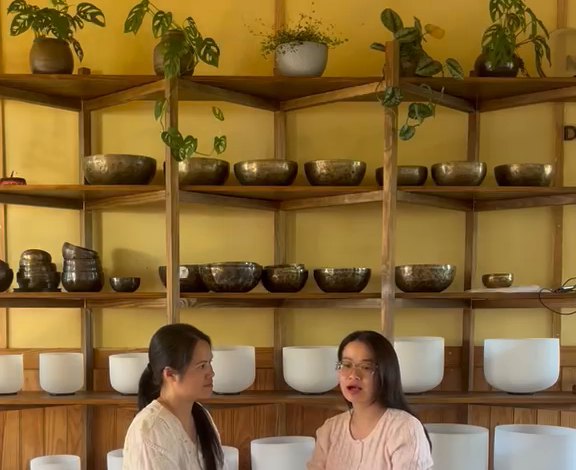
On the 30-hour course, you choose one of these two kinds to learn. Tuition and schedule are the same.
Himalayan, made of metal. You learn to strike, play around the rim, place bowls on the body, and use a Gong.
Made from quartz. You learn to strike and rub the bowls, keep the volume gentle, and combine several notes.
In the clip, Thanh simply calls it the singing bowl course. If you are not sure which kind suits you, message me before you come to Da Lat.
Thanh’s last words
“You really care, and you taught me so much.”
Praise makes me a bit shy. But these are Thanh’s words, so I keep them.
One honest thing: 3 days is enough to learn how and to get started. Your skill grows over the sessions you do after that.
That is also why, after the course, students usually get to practise with the studio’s clients.
The 30-hour course in Da Lat, in short
- 3 daysin person
- Bowl typeTibetan or crystal
- Your dates1:1 or group
- Bowlsready at the studio
What you learn in 3 days
- How to strike, play around the rim and place bowls on the body (called on-body technique).
- How to use a Gong, and how to lead a Sound Bath: a session where several people lie down and listen to the bowls.
- If you choose crystal singing bowls: how to strike and rub them, keep the volume gentle, and combine several notes.
- How to arrange sounds so the listener can relax, and the safety basics. This is relaxation care, not medical care.
After the course, you can run a 1:1 bowl session for one person and hold a Sound Bath on your own.
You get PPTX slides and videos to review. The Certificate of Completion is issued by Giang Metta Academy; the program is accredited by IPHM (UK). This certificate is not a medical licence.
See the 30-hour in-person course →
This is Thanh’s experience. Not everyone feels the same after the course.
You may be asking
How long is the 30-hour singing bowl course in Da Lat?
3 days in person at the studio in Da Lat. Dates are arranged with you, 1:1 or in a group, so message me to pick your days.
Tibetan or crystal singing bowls: which should I learn?
You choose one kind to learn: Tibetan singing bowls (Himalayan) or crystal singing bowls (made from quartz). Tuition and schedule are the same. Not sure which one suits you? Message me first.
Do I get to practise with clients after the course?
After the course, students usually get to practise with the studio’s clients, as Thanh says in the clip. It is a place to practise, not a job promise.
Do I need to buy bowls before the course?
No. The studio has bowls and tools for class. Once you know which sound you like, you can choose your own bowls later.
Read more
Emma, a yoga teacher from Portland, on the singing bowl course in Da Lat → How I teach singing bowls in class: the series →Thank you, Thanh.

Giang Metta (Hoang Huong Giang)
IPHM Certified Sound Healing Practitioner (UK) · Yoga teacher, E-RYT 500 & YACEP (Yoga Alliance)
Giang Metta Academy — IPHM Accredited Training Provider (No. IPHMNC22210) · RYS 200 & RYS 500