Singing bowls in Da Lat · Student review
I asked Emma two questions about the singing bowl course in Da Lat
Then I said: that’s enough. Emma told the rest. At the end, her mum and dad came into the picture.
Giang Metta · 1:48 clip · Vietnamese and English subtitles
Emma kneels on a white mat. Behind her is the studio’s wall of singing bowls.
I sit down next to her. I haven’t asked anything yet, and we are both laughing.
Emma is from Portland, Oregon. She did her 200-hour yoga teacher training with me first. This time it was the singing bowl course.
My interview style: two questions. That’s it.
Read every line of the clip
(laughter)
Hi, my name is Emma Harbison.
I am from Portland, Oregon,
and I just finished my 50-hour sound healing course.
And what do you think about the sound healing course?
I really enjoyed the sound healing course.
I think it taught me a lot about the chakras, a lot about the human body,
and the way that our brainwaves work, about the musical notes.
and I think it’s a nice complement for me as a yoga teacher
to be able to play the singing bowls
and bring my students into a state of deeper relaxation.
Yes, and about the space in Da Lat?
The space in Da Lat is amazing.
My teacher is amazing.
It’s a really special place.
I have really enjoyed my time here.
Yes, that’s enough for me. Thank you so much.
(Giang invites Emma’s parents to join the photo)
Hello, thank you.
We loved it.
Yay!
Question 1 · “What do you think about the course?”
Four bowls on Emma’s shelf
Emma named four things the course taught her. I put each one on the shelf as a bowl.
Tap a bowl to read my note next to it.
01Chakras“a lot about the chakras”
Giang’s note
I teach the chakras as a traditional symbolic system, together with musical notes and colours.
It is not an anatomy map. And it is not for diagnosing anyone.
02The human body“a lot about the human body”
Giang’s note
Before you put a bowl on someone, you need to know who they are.
The course covers contraindications and screening questions before a session. For example: the first trimester of pregnancy, a pacemaker, a history of epilepsy.
03Brainwaves“the way that our brainwaves work”
Giang’s note
Let me be straight here.
In class we talk about brainwaves and the research. But there is not enough evidence yet to say singing bowls synchronise brainwaves.
A singing bowl teacher needs to know where that line is. So you don’t over-promise to your own students.
04Musical notes“about the musical notes”
Giang’s note
Every bowl has its own note and overtones. Put two bowls side by side: sometimes they sit well together, sometimes they clash.
Your ears hear it first. Then your hands choose the bowl.
Emma’s words are in quotes, as she said them. The notes are mine.
Why would a yoga teacher learn singing bowls?
“I think it’s a nice complement for me as a yoga teacher, to be able to play the singing bowls and bring my students into a state of deeper relaxation.”
Emma didn’t learn singing bowls to change careers. She learned them to add something to her yoga classes.
To me, that is a very practical reason.
First yoga, now singing bowls
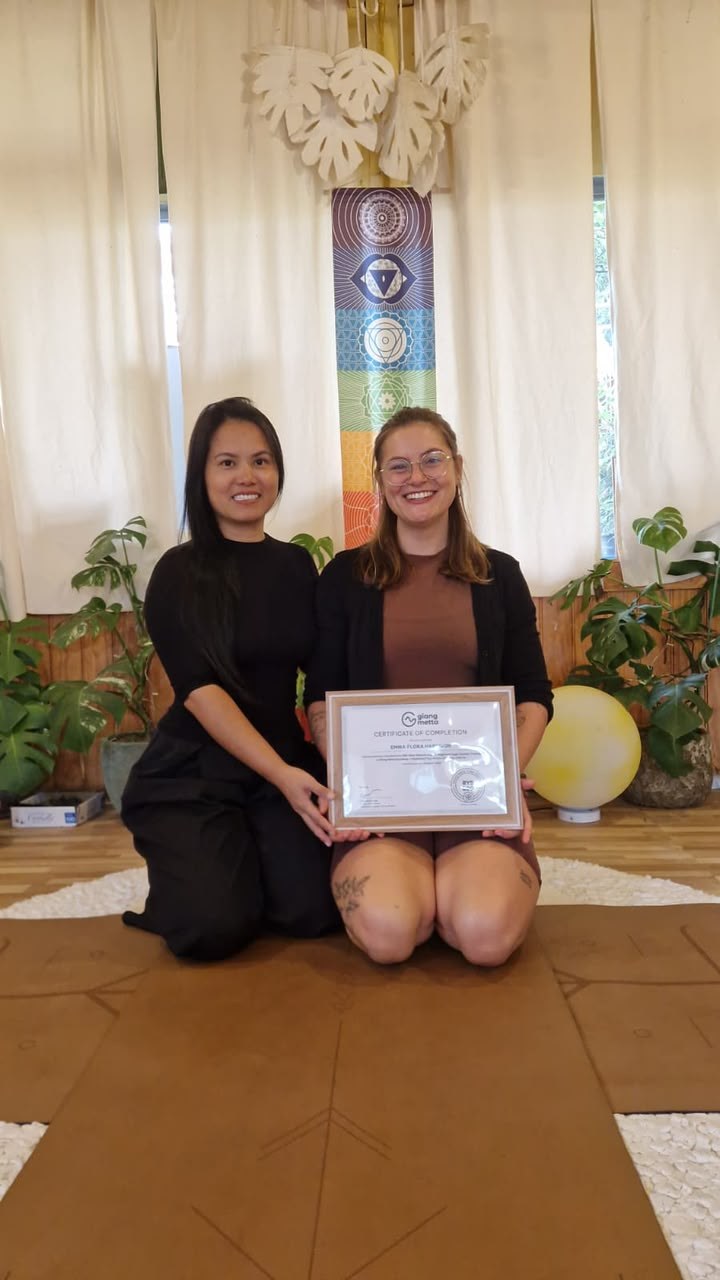
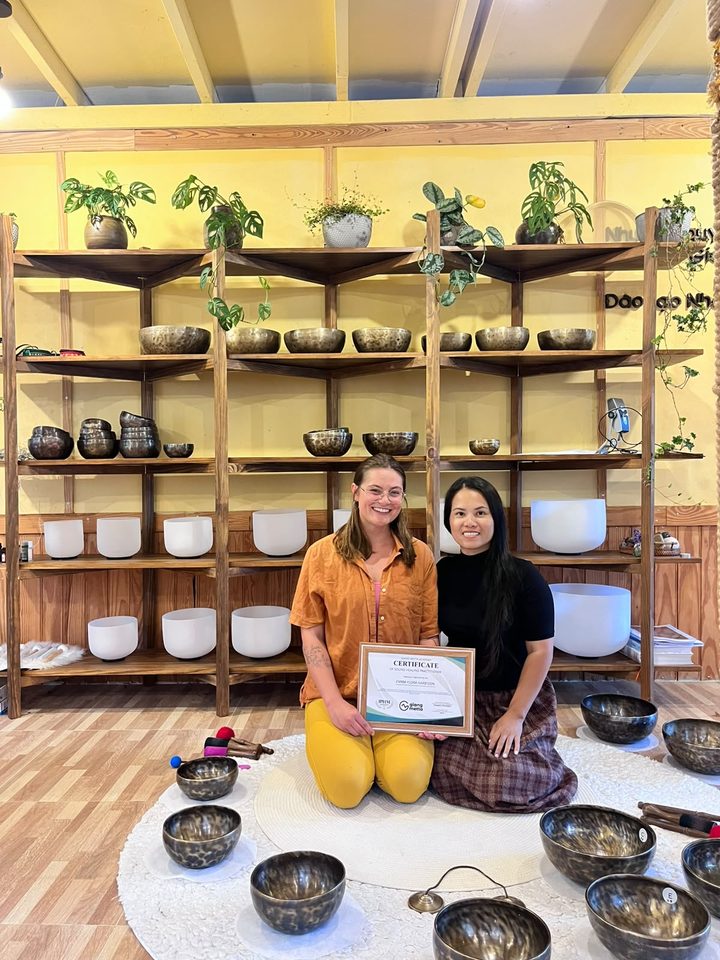
Two photos, the same smile.
Emma trained as a yoga teacher first. Now she also knows how to use singing bowls in her classes.
Both are Certificates of Completion issued by Giang Metta Academy. The singing bowl program is accredited by IPHM (UK).
To be clear: this is not a medical licence.
Question 2 · “And what about the space in Da Lat?”
A room with a whole wall of bowls
“The space in Da Lat is amazing. My teacher is amazing.”
The second line made me a bit shy. But those are Emma’s words, so I’m keeping them.
Yellow walls. Wooden shelves. Brass bowls row by row, with white crystal bowls in the middle. You can see it in the clip.
When you study here, you don’t need to bring or buy bowls. The studio has them.
The whole family joins in
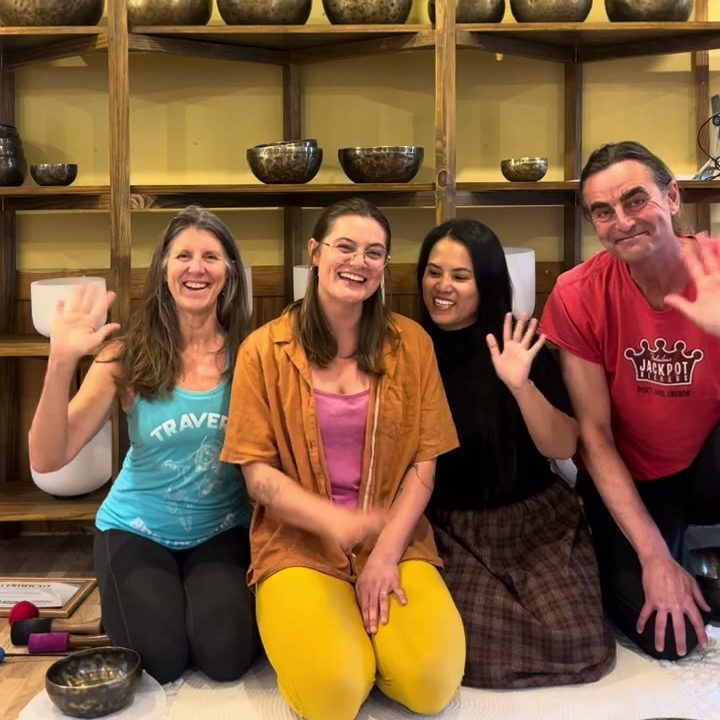
Emma’s mum and dad were at the studio that day too.
After my two questions, I asked them to join us for a photo. Her mum came in first. Then her dad.
Four of us in one row, waving. Her mum said: “We loved it.”
I didn’t ask that one.
The singing bowl course in Da Lat, in short
- 3 daysin person (30H)
- 1:1or a small group of up to 4–6
- By appointmentdates agreed before you travel
- Bowls providedat the studio
Four modules
- Sound and listening. Overtones, resonance, Nepalese 7-metal Full Moon bowls.
- Technique. Striking, rim-playing, placing bowls on and around the body. Gong.
- Guiding a Sound Bath. Planning one session from start to finish.
- Safety and ethics. Volume, contraindications, screening questions.
You choose Himalayan singing bowls or crystal bowls; the price and dates are the same. The goal of the 3 days: you can run a 1:1 singing bowl session and hold a Sound Bath on your own.
See the 30-hour in-person course →
This is Emma’s experience. It is not a promise that everyone will feel the same.
You might be asking
How long is the singing bowl training in Da Lat?
The 30H course is 3 days in person, 1:1 or in a small group of up to 4–6 people. You choose Himalayan singing bowls or crystal bowls. Dates are by appointment. If you travel from far away, you can study full days in a row. If you live nearby, the days can be spread out.
Can I take the course in English?
Tell me your preferred teaching language when you get in touch, and we confirm it for your class before you travel.
Should a yoga teacher learn singing bowls?
It depends on your classes. Emma learned so she could bring bowls into her yoga classes. If you want the same, the course is a place to start. If you only want to lie down and listen, one Sound Bath is enough.
Do I need to buy singing bowls before the course?
No. The studio has bowls and equipment for class.
Is the certificate a medical licence?
No. It is a Certificate of Completion issued by Giang Metta Academy. The program is accredited by IPHM (UK). It does not qualify anyone to diagnose or treat.
Read more
Emma’s review of the 200-hour yoga teacher training → Thanh’s review: who she used the bowls for after the 30-hour course → How I teach singing bowls in class: the series →Thank you, Emma’s family.

Giang Metta (Hoang Huong Giang)
IPHM Certified Sound Healing Practitioner (UK) · Yoga teacher, E-RYT 500 & YACEP (Yoga Alliance)
Giang Metta Academy — IPHM Accredited Training Provider (No. IPHMNC22210) · RYS 200 & RYS 500