Learning to guide singing bowl practice · Da Lat bowl class
Learning to lead a Sound Bath: follow the lesson, then try it
Giang Metta · 3 min read · 1 class clip
My learner circled each bowl on its own, and each one sounded. When she used both hands on two bowls, the sound did not come up the way she wanted. I let her pause one side and practise again.
This was a class in Da Lat on leading a Sound Bath: how to guide people who lie down and listen to the bowls. She was practising with me. She was not leading guests on her own yet.
Before this two-bowl part, the class went through three things: opening the course notes, practising the introduction, and preparing the place to lie down.
Keep the course notes beside you
At the start, she opened the lesson on her phone. She likes her iPad better, so I told her to bring it next time to see more easily.
I do not ask her to memorise everything first. The notes stay beside her. She reads a bit and tries a bit. While a bowl is still ringing, she can look at the next part. No need to rush.
When I teach, I open the lesson for learners to read with me too. If you need to look at the notes, look. There is nothing to be shy about.
But the theory still has to be read and understood: which tools to use, how to set up, what to watch for with the listener. Having the lesson in front of you does not mean following it line by line without knowing what you are doing.
Her room and her set of bowls do not have to look like my studio. We read the order in the lesson, then work out how to do it with what she has.
At the part that introduces the bowls, she asked if she should try it right away. I said yes. Reading tells you what is in the lesson. Trying tells you where you need to ask.
Inviting the listener to lie down needs practice too
At the part about inviting the listener to lie down, I took out a blanket, a pillow and props to show her.
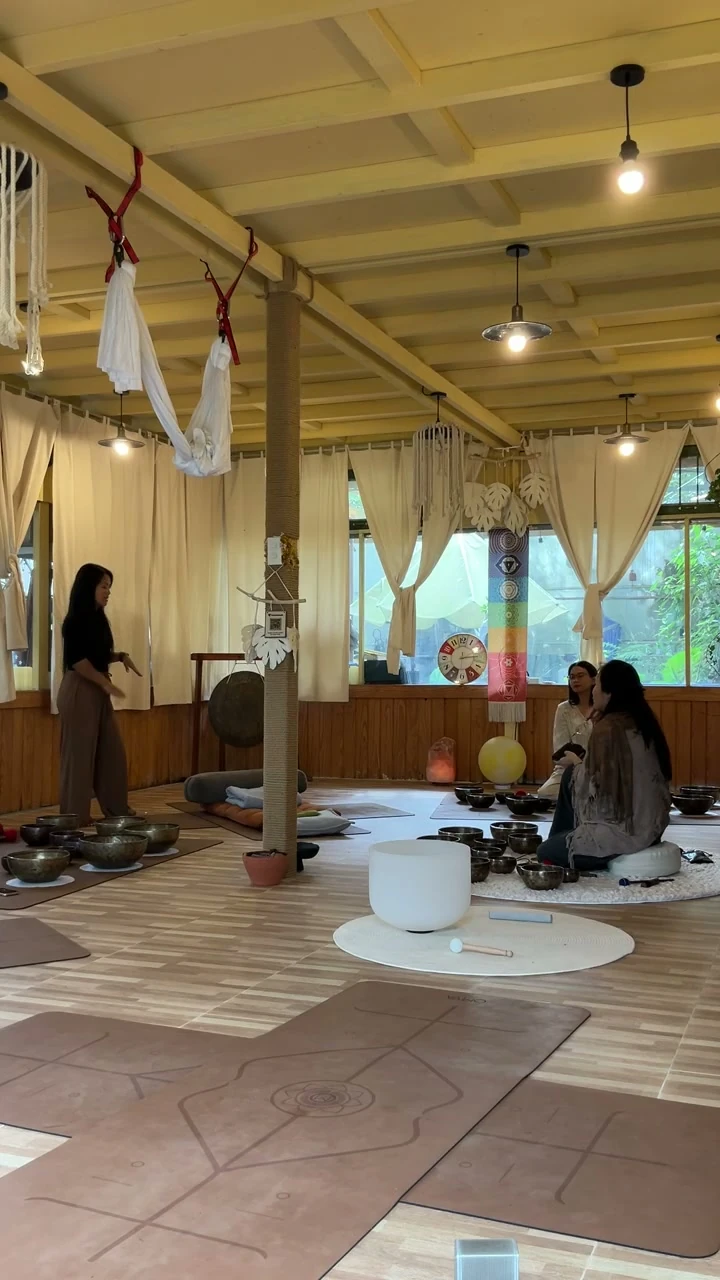
The mat in the room is a bit thin, and Da Lat is often cold, so I prepared an extra blanket and pillow. Before starting, the person leading needs to welcome the guest, explain how the session will go, and help them lie down comfortably.
Then she and I went back to the lesson: what we had just done, and what comes next. The lesson also has a part where you ask the participant what they hope for from the session.
Reading the invitation to lie down is easy. Preparing enough before you invite is harder. In a different room, she has to check what is there, not carry my layout over as it is.
Two bowls, one spot to practise more
Then came the part on circling more than one bowl, the moment at the top of this article.
I showed two ways:
Way 1
Use two mallets and circle both bowls at the same time.
Way 2
Get one bowl sounding, then move to the other while the first sound is still ringing.
She asked again, then tried.
With both hands at once, she could not keep both sounds going. One bowl at a time came up more easily.
The course notes tell her the order of the steps. When she tried it, I could see where she needed more practice. That day, coordinating two hands was hard for her. So I let her pause one side, practise the bowl that was not sounding first, then try both again.
After the clip, I still reminded her: slower, lighter.
The next part of that practice is in Singing bowl sounding harsh? Slow down.
Just practise that spot again.
About the sources of this article
This article retells one in-person class in Da Lat. The conversation is paraphrased from the class recording. The two-bowl scene is moved to the top, then the article goes back to the start of the class. The clip keeps the original words and picture, with Vietnamese subtitles on top and English below. The volume was raised so it is easier to hear.
This is guided practice. It is not a guide to running a Sound Bath on your own just by reading the course notes.