Singing bowl series · Arranging crystal singing bowls
Arranging crystal singing bowls: which bowl goes next to which?
Seven crystal singing bowls (made of quartz) on a round mat. Two hands play two bowls at once. If a hand can’t reach, the mallet hits the side of the bowl. So I arrange the bowls by interval: how far apart two notes are.
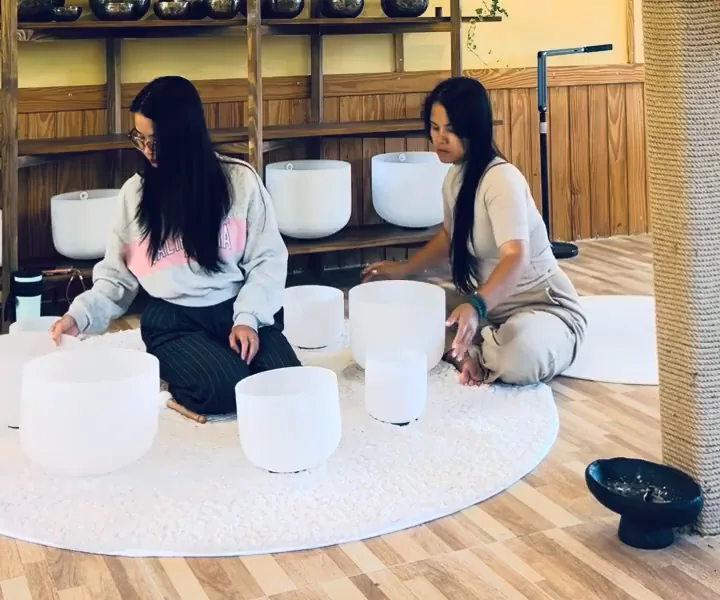
Try this first
Seven bowls, two ways to arrange them
Indoors: fourths sit side by side
Four pairs: C–F, D–G, E–A, F–B. F is in two pairs, so C, F and B make one group of three bowls.
Tap a pair to count the note names:
Outdoors: fifths sit side by side
Three pairs: C–G, D–A, E–B. Only three pairs, so less to move.
Tap a pair to count the note names:
- C
- D
- E
- F
- G
- A
- B
Why pairs sit close
If your hand can’t reach, the mallet hits the bowl
In this class I teach how to arrange the bowls before anyone plays them. I say why right at the start:
“So you don’t have to stretch both arms out sideways. When your hand can’t reach, the mallet hits the side of the bowl straight away.”
The bowls don’t need to touch. I add: one bowl in between is fine, or just close together.
Then I sum it up: “Just those two rules.” The clip doesn’t say why outdoors switches to fifths, so I won’t guess here.
I ask, the learner finds it
I don’t read out the answer
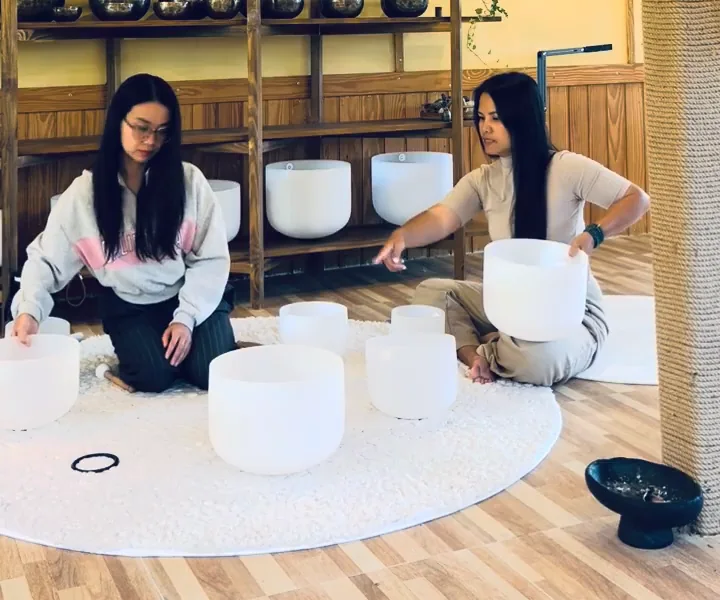
I leave the big bowls where they are. Then I ask the learner to place the small bowls that go with them.
Giang“C, a fourth: which one goes with it?”
Learner“F.”
Then D. The learner finds G, and we move the bowls so those two sit close.
Placing the bowls isn’t the end. I point at two bowls and ask again:
Giang“Are these two linked to anything else?”
Learner“Only these three are linked to each other.”
Those three bowls belong together. These two don’t, not yet. The learner sees it and moves them.
Check by counting
Count on your fingers
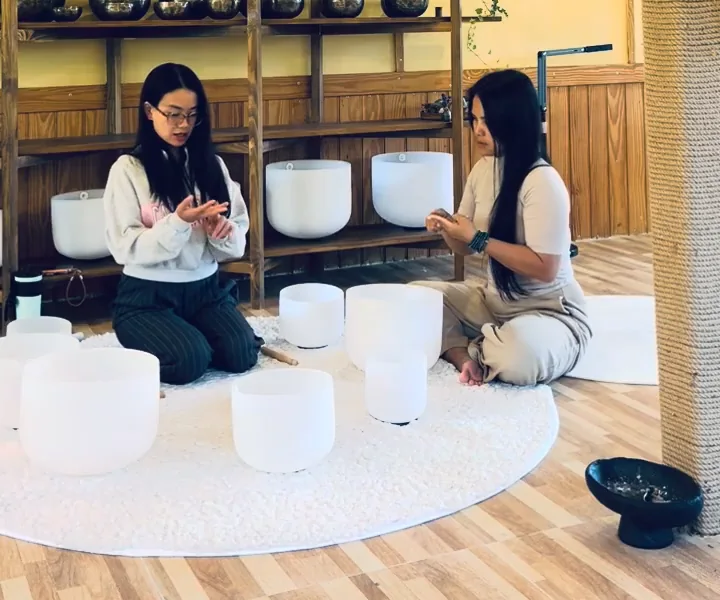
Is a pair really a fourth? The learner doesn’t guess. They count the note names on their fingers.
Giang“It’s four. A fourth.”
Learner“C, D, E, F. That’s four.”
Count the first note name and the last one too. Then count every pair the same way: D–G, E–A, F–B. The board at the top of this page does exactly that.
Then play
Play the whole set, one pair at a time
Once the bowls are in place, play through every pair, first to last: C–F, D–G, E–A, F–B. Two mallets circle two bowls, and you hear two sounds ringing together.
I give two small reminders. Turn your whole body toward the pair you are playing. And next time, wear fitted clothes so your sleeves don’t brush the bowls.
Playing two bowls on someone lying down brings other things to watch. I wrote about that in Two singing bowls at once.
Outdoors
Fifths: only three pairs
Learner“C with G.”
Learner“D goes with A.”
Learner“E goes with B.”
“With fifths it’s three. … Three is a lot easier.”
Count C, D, E, F, G: five note names, so C–G is a fifth. F has no pair in this set-up. The learner sees that only three small bowls need to move.
For people learning to teach
Three checks before you play
- Indoors or outdoors?Two places, two ways to arrange.
- Does the count come to four or five note names?Indoors it’s four. Outdoors it’s five.
- Are both bowls of a pair within reach of your hands?If your hand can’t reach, the mallet hits the side of the bowl.
When the set is ready, take a photo so you have something to check next time. I ask learners to take it so the note names can be read in the photo. Then I say one thing:
“Just remember the rule of the intervals.”
Arrange. Then count again.