Not Flexible Enough for Yoga? Use the Pose to Learn Your Body
"I don't think I will ever be able to do this."
I hear this a lot, especially in 200-hour teacher trainings. Sometimes from someone who started yoga a few weeks ago. Sometimes from someone who has practised for years and still can't get into one pose.
Every time, I remember my own first yoga class.
I bent forward. My hands did not reach the floor, even with my knees bent as far as they could go. The teacher said "breathe in", and I breathed out. She said "breathe out", and I held my breath. The whole class stood on one leg like cranes. I wobbled like a chair with one short leg.
A stiff block of wood. Today that block of wood trains yoga teachers.
So my short answer is: yes, you can do yoga if you are stiff.
The long answer is more useful. "You can practise" does not mean "you will do every pose in the photos". And "stiff" is not just one thing.
This article is for you if you feel too stiff to start. And for you if you are training to teach, because you will meet many people like this.
In this article
- Do you need to be flexible first?
- What "stiff" really means
- Stiff is not always a weakness
- Don't use the body to get into the pose
- "Your body, your yoga; your day, your yoga"
- Stretch or pain? Two very different things
- "If you can feel it, you can work with it"
- A ten-year habit doesn't change in one session
- If you are stiff, how do you start?
- If you are training to teach: "I can't do it"
- Questions beginners often ask
- Last words
In short
- You don't need to be flexible before you start. Being stiff does not exclude you from yoga.
- "Stiff" has several sources: muscles not used to lengthening, a cautious nervous system, the shape of your bones, years of habit, and how your body feels today.
- With regular practice, range of motion (how far a joint can move) usually improves. But nobody can promise you every pose. Some limits come from bone, not from laziness.
- How I teach: we don't use the body to get into the pose. We use the pose to get into the body. The pose shows you what you already have and what needs its own practice.
- A mild stretch is normal. Sharp pain, numbness or tingling means stop.
- Stiff people often have their own strengths. Flexible people have their own challenges.
Do you need to be flexible first?
There is a saying yoga people love, and so do I: saying you must be flexible before you do yoga is like saying you must be clean before you take a shower.
Still, I understand why many people hesitate. Social media is full of people folded in half, legs behind their heads. After a few minutes of scrolling, yoga looks like a sport for people who are already bendy.
Those photos are not wrong. They are just not everyone's destination.
In class, I don't ask students, "Are you flexible?" I ask: how does your body feel today? Where is it tight, where is it tired, where does it hurt?
A different question leads to a different practice.
What "stiff" really means
When someone tells me "I'm so stiff", they usually mean one of the things below. Sometimes several at once.
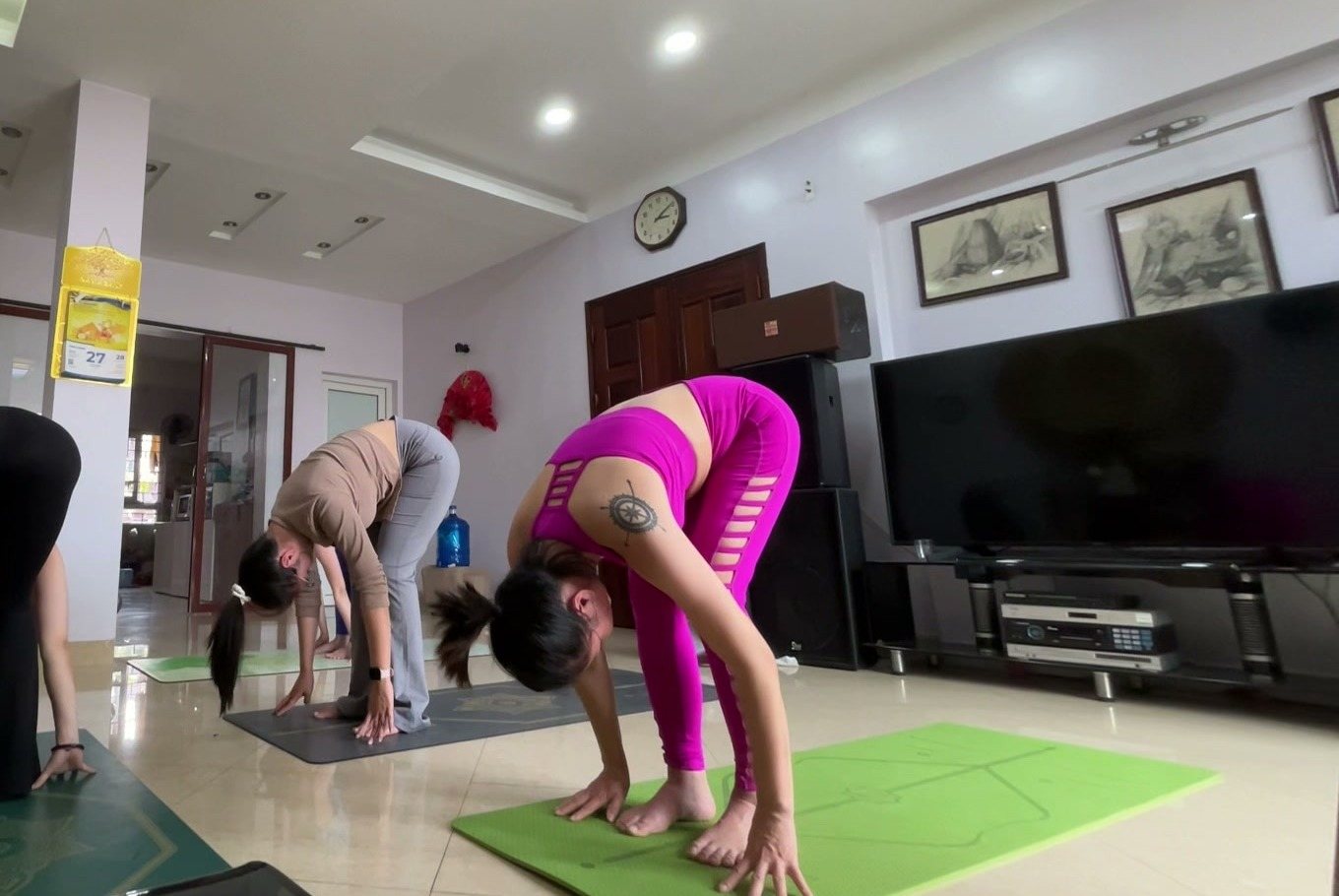
1. Muscles not used to lengthening
Muscles, tendons and the tissues around each joint all have their own elasticity. If you rarely move into a certain range, your body gets used to a shorter one.
Sitting a lot, rarely bending or reaching: the backs of the thighs, the hips and the shoulders usually complain first.
2. A cautious nervous system
This part often surprises beginners.
When you fold forward and feel a pull behind your thighs, it doesn't only mean "the muscle has run out of length". Part of that feeling is your nervous system saying: this is far enough, I'm not used to going further.
Research on stretching shows that after a few weeks, people reach further mostly because they tolerate the stretch sensation better. With longer training, muscles and tendons may also become less stiff. Whether muscles actually get "longer", and by how much, is still not settled in the reviews.1
What I take from this for class: forcing is not a shortcut.
Push too hard and the body holds on tighter. Practise gently and regularly, and the body has time to get used to it, and to trust it.
3. Every skeleton is shaped differently
Many yoga classes skip this part.
Our bones are not made from one mould. Take just one measure: the angle at which the neck of the thigh bone (the part that connects the thigh bone to the hip socket) is turned. Among healthy adults it varies a lot. Your left and right legs may not match exactly, either.2
At the hip, some directions of movement are stopped by soft tissue: muscles, tendons, ligaments and the joint capsule. In some directions, past a certain point, bone meets bone.3
When bone meets bone, you can't stretch "more". Not even after years.
So if you practise regularly and one pose still won't come, it may not be because you are lazy or bad at yoga. Your frame may simply take a different path.
But to be honest: don't diagnose yourself by feel. A "blocked" or "jammed" feeling can't tell you whether it is bone, muscle or an injury. If it hurts or worries you, ask a medical professional.
4. Years of habit
Eight hours a day at a computer, for years. Looking down at your phone in every spare minute.
The body is very good at learning whatever we repeat every day. Including things we don't want it to learn.
You can't change a ten-year habit in a few classes. I'll come back to this below.
5. How your body is today
Many people feel much stiffer just after waking up. You are not imagining it.
Studies that measure people several times a day find that range of motion, especially in the spine, tends to be lower early in the morning and higher in the late afternoon or evening. How big the difference is depends on the person and on how it is measured.4
Being sick, sleeping badly, stress, a long trip: the body changes too.
The same person is different today than yesterday.
Stiff is not always a weakness
When I teach, I often remind students that stiff bodies and flexible bodies each have their advantages.
From what I see in class, stiff students are often good at poses that need strength: bearing weight on the hands, holding the trunk, standing steady. Flexible students get into deep bends more easily, but they have to learn to hold back and not let the joints go too far.
This is a teacher's observation, not a rule.
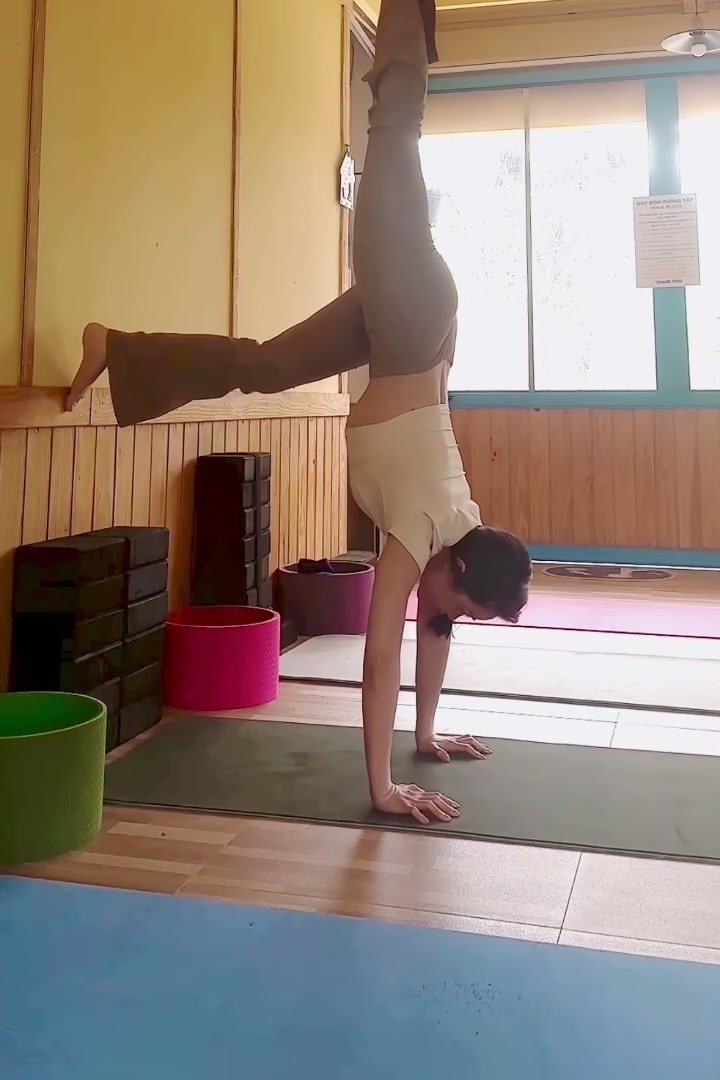
Research on people with naturally loose joints (joints that move further than usual; in medicine this is called joint hypermobility) gives mixed results. One study found this group sensed joint position less accurately in some measures, but they were not weaker in grip strength or balance tests.5 So don't rush to label anyone, including yourself.
One more thing that may comfort stiff people: strength training done well also improves range of motion. Reviews comparing the two found that training with weights or elastic bands and stretching gave gains that were not clearly different.6
So if you want to move more freely, pulling and pulling and pulling is not the only road.
Don't use the body to get into the pose
There is one sentence in my curriculum that every student has to explain in their own words:
The first time they hear it, most people are puzzled. I usually explain it with wheel pose.
Wheel is beautiful, and just hard enough that everyone wants to conquer it. You lie on your back, place your hands and feet, and push your whole body up into an arch.
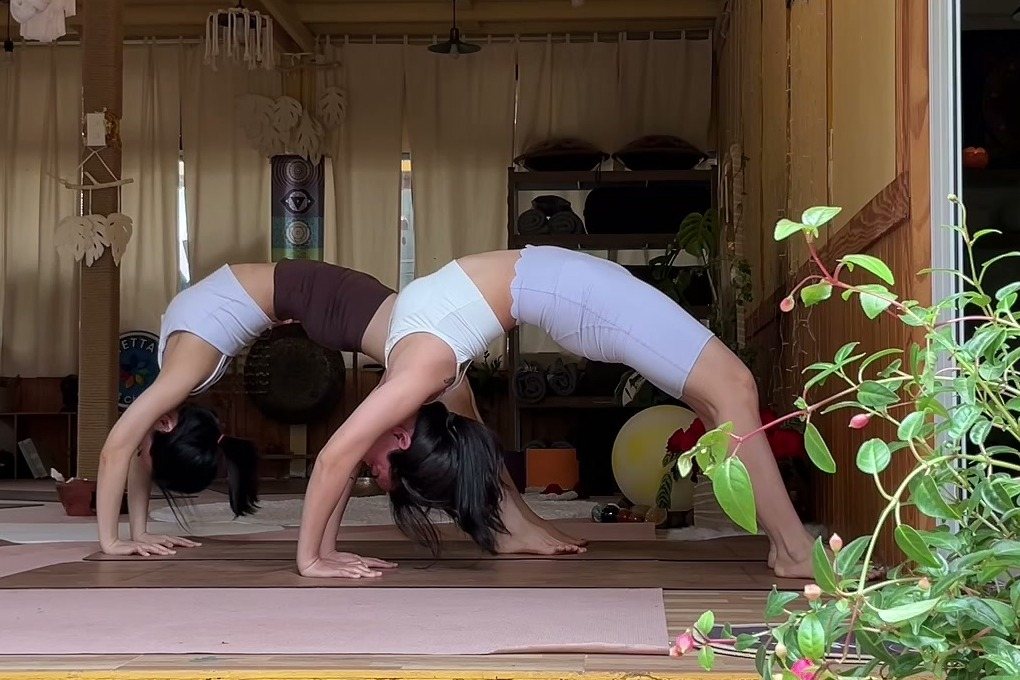
I once had a student who really wanted to do wheel. The hips could lift. But the arms could not straighten yet to push the shoulders and chest up.
Option one: keep trying the full pose, again and again. Or ask the teacher to lift, press and hold them up at any cost.
At that point the person helping is almost carrying the student. And when you are carried, the missing part is still missing.
Option two: see the wheel as separate parts.
- The hips can already lift. Notice that. You don't need to lift your hips until you are exhausted every time before you train anything else.
- The arms are not strong enough to push yet. Train arm strength on its own, for example push-ups with your knees on the floor.
- The shoulders are not open yet. Tight shoulders hold you down and the arms stay bent. Train shoulder opening on its own. Some of it you can even do sitting.
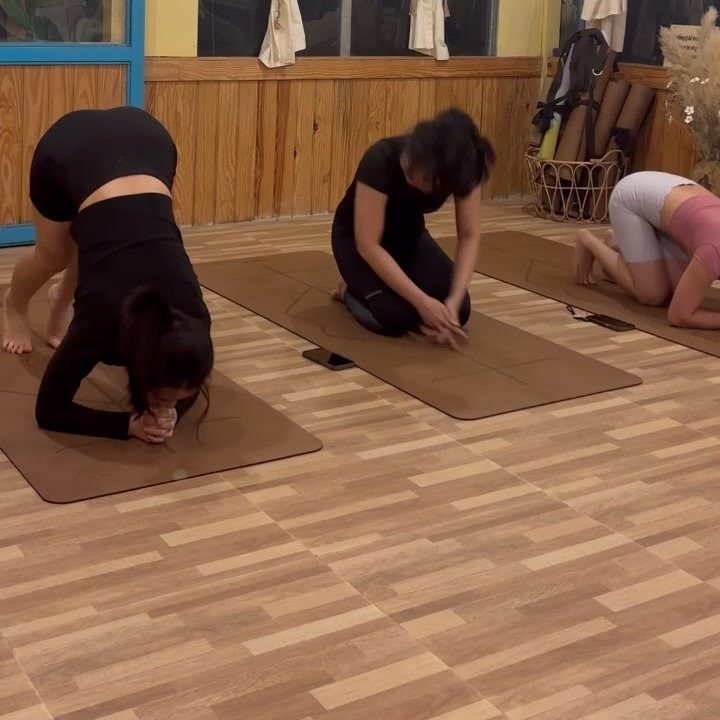
When the arms and shoulders are more ready, you put the parts back together into the pose.
That is "using the pose to get into the body".
A pose is not an exam. It is a mirror. It shows you what you already have and what needs more practice.
One note: wheel is a demanding pose and loads the wrists, shoulders and back. The exercises above were for one particular student. Someone else may need something different. If you have problems with your spine, shoulders or wrists, ask your doctor before you think about wheel.
"Your body, your yoga; your day, your yoga"
I keep this line in English on my slides, even when I teach in Vietnamese, and ask students to explain it.
The first half is about your build. Stiff or flexible, large frame or small frame. Everyone has their own map.
The second half is about today. On a good day, poses feel easy. On a day with a cold, you fold forward and your nose is blocked. On that day, a gentle practice, a short practice, or rest is also yoga.
Some people blame themselves: "I could do it yesterday. Why not today?"
You are not going backwards. You are just having a different day.
Compare yourself with yourself, not with someone in a photo. And remember that you also have good days and bad days.
Stretch or pain? Two very different things
Stiff people often go to one of two extremes. Either so afraid that they never go anywhere. Or so stubborn that they grit their teeth and push on.
I give students a simple way to tell the difference:
- Stretch feels like pulling, warmth, mild discomfort in the belly of the muscle. You can still breathe. It eases when you come out of the pose.
- Pain is sharp, stabbing or electric, in a joint or at one small point. Or numbness and tingling that spreads.
A mild stretch is normal. Don't go into pain. If it hurts, back off until it stops hurting. If you feel sharp pain, numbness or tingling, stop the movement completely.7
If pain lasts, gets worse, or you have an injury or a medical condition: ask your doctor.
There is one more measure I use even more: your breath.
If you have to hold your breath to stay in a pose, clench your jaw, or frown, you are further than your body allows today. Back off a little. Where you can breathe, you can feel.
"If you can feel it, you can work with it"
There are two lines in my curriculum that I use to encourage students:
If you can feel it, you are already doing it.
What I mean is this. A tight spot is the body speaking up. A weak spot is a place that needs strength. As long as you can feel, there is something to work with.
But I need to be clear, so the encouragement does not turn into a promise.
Feeling it does not mean you will be able to do every pose. There are limits from your skeleton, your age, your health. And pain does not mean you are making progress.
The line is about attitude: don't close the door on your own body just because you can't do something today.
A ten-year habit doesn't change in one session
Recently I taught alignment to a student who was learning from home, through a screen.
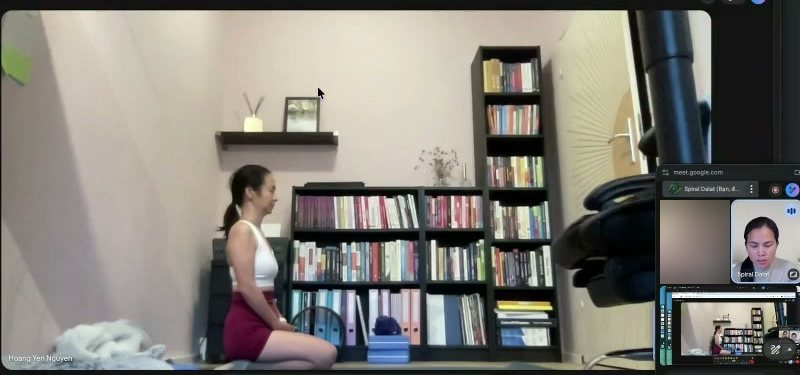
I guided her to sit again: the two sitting bones (the two points of bone under your buttocks that touch the floor when you sit) as a base, the back where it should be, the head over the shoulders. In the screenshot, the posture looked much more balanced.
She said she felt as if she might fall, even while sitting.
Then she tensed up and held her breath to stay there. After a while, without noticing, her body drifted back to the old shape.
This is very normal. After years of sitting one way, the body thinks that way is "straight". A new posture, even a better one, feels strange and wobbly at first.
Strange does not mean wrong.
What did I do? I didn't ask for more effort. I had her lean her back against a wall, so there was support while she learned the feeling and kept her breath steady. If you stay rigid and tense all the time, learning takes longer, is more tiring, and can make you afraid.
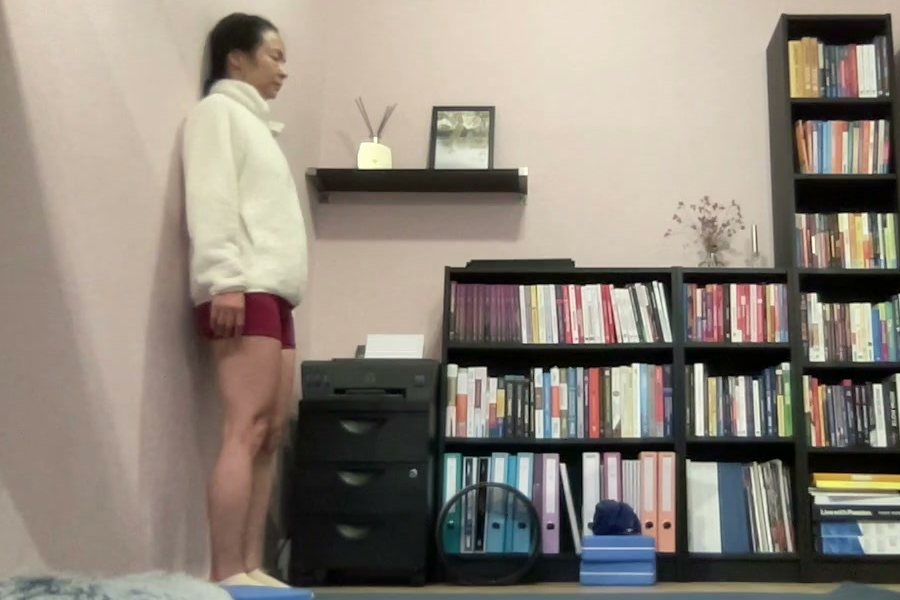
I was also direct about expectations. A ten-year habit does not go away in a few days or a few months. Our job is to notice it, then change it bit by bit, with awareness.
Repeat until it becomes a reflex. Doing it today does not mean you will remember tomorrow.
In 200-hour teacher training, I sometimes spend a whole month coming back to a few basic poses. Not because students are slow. Because bodies need time.
And I don't ask for one hundred percent. In class, a teacher and a student can study a photo and pick at every detail. In real life, sitting like that most of the time is already very good. Checking every detail all day is exhausting. Nobody can keep it up.
To be fair, I'm the same. Every time I remind a student to sit up straight, I ask myself: am I straight?
When I'm busy, I slump like everyone else.
What I remember most about that lesson
Not the old posture. The way she learned.
She told me exactly what she felt. When her heels took most of the weight, she said so. When she felt wobbly, she said wobbly. That told me what to adjust next, together with her.
When I teach through a screen, I can't adjust a student with my hands. What she tells me about her body does that job. I'm grateful for a student like that.
I asked her to lift all ten toes. On the very first try, she felt the weight move onto the balls of her feet, where before she only felt her heels.
She asked very good questions. When I move my upper body back, does my neck slide forward? When I walk, do I also lean forward without noticing?
Asking like that means you have started to see yourself.
At times she got tired, with uneven tension in her legs, first one side, then the other. She said the tight and loose spots kept changing, and she couldn't settle. She runs, so I didn't think it was weakness. My guess is that most of the tiredness came from paying attention to one spot after another. I asked her to sit down and rest. After the break, she carried on.
After leaning on the wall and breathing for a while, she said her body felt lighter and she was starting to get used to it. Then she noticed on her own that she was sitting unevenly, more weight on the left side. Nobody had to tell her.
Later, kneeling upright, she looked at the photo and saw for herself that she was straighter. That made me happiest. Not because the shape was perfect. Because she saw the difference herself, without waiting for her teacher to grade it.
Then she said something I wish everyone training to teach would think of: if I can't sit like this yet, many other people must find it hard too.
That is the moment a student starts to become a teacher. Your own difficulty turns into understanding for someone else.
In the anatomy part, I asked her to recall the points along the spine from the bottom up. I helped with one name, she repeated it, and went on to the top point. We even agreed that this kind of body knowledge should be taught in secondary school.
Her future students will have a teacher who once felt as if she might fall when sitting up straight. And who patiently worked through that feeling.
If you are stiff, how do you start?
There is no single lesson plan for all stiff people. But a few things help almost every beginner I teach:
- Let your knees bend. Fold forward with soft, bent knees. The goal is a long back and easy breath, not hands on the floor.
- Use props without shame. Blocks, straps, a chair, a wall. Props are not cheating. They bring the floor closer to you.
- Short and regular beats long and rare. Fifteen minutes a few times a week is easier to keep than one two-hour session followed by three sore days.
- Build strength alongside flexibility. Push-ups with knees down, standing poses held a little longer. Strength lets you hold the range you have just opened.
- Break your dream pose into parts. Ask: which part do I already have? Which part is missing? Train the missing part on its own.
- Write down one thing you felt after each practice. Not "did I touch the floor". Something like "breathing was easier in tree pose today" is enough.
- Learn with a teacher who can see your body. Especially at the start, or if you have health problems.8
Yoga can improve flexibility. How much depends on the person, the practice and how it is measured.9
I can't tell you how long it will take to touch the floor. What I have seen in many students: practise regularly, don't force, and people start to understand their own bodies.
And once you understand your body, practice gets easier.
If you are training to teach: "I can't do it"
In my 200-hour teacher trainings, I hear "I can't do it" very often. Those are the students I have taught. I can't say it's the same everywhere.
It took me a long time to understand something: often, students say this because they need encouragement. Not because they have made a final judgment about themselves.
A teacher can answer in two ways.
The way that makes students quit: "You're so stiff." "I've shown you so many times and you still can't." "How long will this take?" "You'll probably never get it."
I once read posts on Threads from people complaining about "toxic" teachers. They were called stiff, criticised for not getting it after being shown. They asked a fair question: I'm stiff and I can't do it yet, that's exactly why I came to class. Why use that against me?
People leave a teacher like that. Some leave yoga altogether.
The way I train my students to answer:
- Ask before you advise. What feels hardest for you today?
- Point out what they can already do, honestly. "You did better than yesterday." Only say it when it's true.
- Break the missing part into one thing they can practise today.
- Let the student choose. Work on a supporting exercise, or try once more with a strap or the wall.
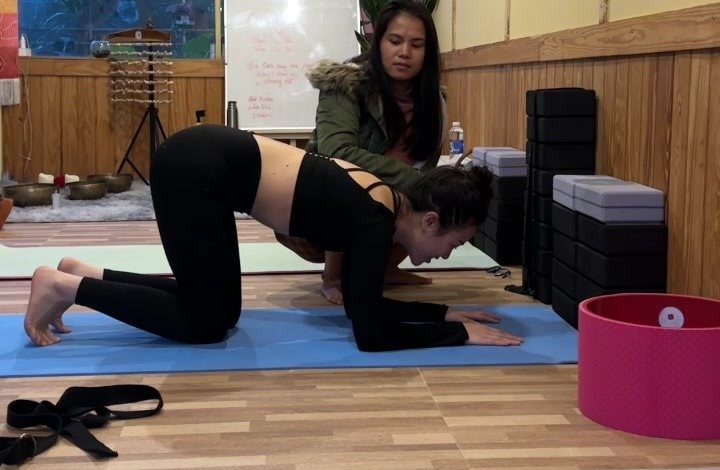
I'm not saying praise everything. Students know when praise is fake.
But motor-learning research also notes that learners who expect to do well, and who get some choice in how they practise, tend to learn movement skills better.10
A teacher's job is not to put students in a box marked "will never improve". People come to class carrying their difficulties. We are there to walk alongside those difficulties.
This job is not easy. Other people's bodies are not like yours. Whether you are flexible or stiff, you have to learn again how to look at a different body.
I have one small advantage: I used to be the block of wood. I still remember wobbling in a room full of cranes.
Questions beginners often ask
Can a stiff person train to be a yoga teacher?
Yes. My 200-hour online yoga teacher training builds a Hatha foundation from the beginning. You don't need to be flexible or able to do advanced poses before you start. What matters more is practising regularly and being willing to observe your own body.
I'll also be honest: after the course, you have to stand in front of a class on your own, and that class will have every kind of body. People who were once stiff often understand stiff students better.
How long until I'm flexible?
I can't answer with a number. It depends on your build, your age, how much you practise and how.
Some people find folding forward easier after a few weeks. Some poses never come in a lifetime, because of bone shape. Both are normal.
I'm older and very stiff. Can I still do yoga?
Many older adults practise yoga. A review of studies in people aged 60 and over found a small-to-moderate average improvement in flexibility.9
Start slowly and choose a suitable class. If you have heart disease, osteoporosis, joint degeneration, or recent surgery, ask your doctor first.
Should I ask someone to push me deeper?
I don't recommend it. The person pushing can't feel what you are feeling.
Good support helps you find the right place. It doesn't push you further than your body allows.
I'm very flexible. Is there anything to worry about?
Yes. Flexible does not mean stable.
Flexible people need to learn to hold, to use strength, and to not go to the end of their range just because they can. If your joints often dislocate or hurt, see a doctor.
I feel stiff in the morning. Should I practise in the morning?
You still can. Warm up longer, move into poses more slowly, and don't compare with yesterday afternoon's practice.
Last words
Being stiff is not a reason not to practise. It is a reason to practise the right way.
Don't use your body to chase a pose. Use the pose to understand your body.
Go slowly.
References
The teaching ideas in this article come from my own classes. The sources below are for further reading on flexibility, stretching, safety and motor learning.
-
Weppler CH, Magnusson SP (2010). Increasing muscle extensibility: a matter of increasing length or modifying sensation? Physical Therapy, 90(3):438–449. DOI: 10.2522/ptj.20090012. — Freitas et al. (2018). Can chronic stretching change the muscle-tendon mechanical properties? A review. Scand J Med Sci Sports. DOI: 10.1111/sms.12957. — Takeuchi et al. (2023). Long-term static stretching can decrease muscle stiffness. Scand J Med Sci Sports. DOI: 10.1111/sms.14402. — Ingram et al. (2025). Mechanisms underlying range of motion improvements following acute and chronic static stretching. Sports Medicine. DOI: 10.1007/s40279-025-02204-7. Panidi et al. (2023, Sports Medicine – Open, DOI: 10.1186/s40798-023-00591-7) found a very small increase in muscle fascicle length; Ingram et al. (2025) found no meaningful change. ↩
-
Scorcelletti et al. (2020). Review of femoral anteversion measurement. Journal of Anatomy. DOI: 10.1111/joa.13249. — Dimitriou D et al. (2016). Side-to-side variation in normal femoral morphology: 3D CT analysis of 122 femurs. Orthop Traumatol Surg Res, 102(1):91–97. DOI: 10.1016/j.otsr.2015.11.004. ↩
-
Han et al. (2020). The role of soft tissue and bony impingement in hip range of motion (8 cadaveric hips, 3D CT simulation). Journal of Orthopaedic Research. DOI: 10.1002/jor.24594. A small study; not for diagnosing individuals. ↩
-
Gifford (1987). Circadian variation in human flexibility and grip strength. Australian Journal of Physiotherapy. DOI: 10.1016/S0004-9514(14)60579-1. — Russell et al. (1992). British Journal of Rheumatology, 31(5):329. DOI: 10.1093/rheumatology/31.5.329. — Edwards et al. (2026). Chronobiology International. DOI: 10.1080/07420528.2025.2611854. All samples are small; the size of the difference varies by measure. ↩
-
Akaras et al. (2025). Joint position sense, grip strength and function in people with joint hypermobility (83 people, cross-sectional). Scientific Reports. DOI: 10.1038/s41598-025-24199-x. — Smith et al. (2013). Rheumatology International. DOI: 10.1007/s00296-013-2790-4. ↩
-
Afonso J et al. (2021). Strength training versus stretching for improving range of motion: a systematic review and meta-analysis. Healthcare, 9(4):427. DOI: 10.3390/healthcare9040427. — Alizadeh et al. (2023). Resistance training induces improvements in range of motion. Sports Medicine, 53:707–722. DOI: 10.1007/s40279-022-01804-x. In Alizadeh 2023, bodyweight-only training did not show a meaningful increase in range of motion. ↩
-
Mayo Clinic, Stretching: Focus on flexibility (18 Nov 2023) — mild tension is normal; don't stretch into pain; if it hurts, back off. — NHS, exercise safety advice (reviewed 2 Mar 2026) — stop if you feel pain or unwell. ↩
-
NCCIH/NIH, Yoga: Effectiveness and Safety — risks of practice and advice to practise with a qualified instructor. ↩
-
Ko et al. (2023). Effects of yoga on physical and psychological health among community-dwelling older adults: A systematic review and meta-analysis. International Journal of Older People Nursing, 18(5):e12562. DOI: 10.1111/opn.12562. 15 studies, people aged 60+; small-to-moderate effect on flexibility. ↩↩
-
Wulf G, Lewthwaite R (2016). Optimizing performance through intrinsic motivation and attention for learning: The OPTIMAL theory of motor learning. Psychonomic Bulletin & Review, 23:1382–1414. DOI: 10.3758/s13423-015-0999-9. ↩

Giang Hoang
Yoga teacher, E-RYT 500 & YACEP (Yoga Alliance)
Giang Metta Academy: RYS 200 & RYS 500 (YA ID 442630)
Based in Da Lat, Vietnam. Teaching online worldwide.