Sympathetic vs parasympathetic: which is better? Yoga teachers should ask “when?”
At the end of Module 1 in my 300-hour class, I asked the group one question. Everyone there had already finished 200 hours.
When you have to focus on something very important, which system is working harder? Sympathetic or parasympathetic?
The class answered: sympathetic.
Right. So is the sympathetic system bad at that moment?
The question sounds easy. But it stops a habit I see all the time: hear “sympathetic” and think stress, bad. Hear “parasympathetic” and think relaxed, good.
Quick read: sympathetic, parasympathetic and yoga teachers
- The sympathetic system is not bad. It helps you focus, move and react to danger.
- The parasympathetic system is not always the right fit. It looks after rest, digestion and recovery.
- Both branches always work together. The better question: right now, which one should lead?
- Ordering “breathe in deep, breathe out slow” to calm someone down can easily become one more pressure.
- When you explain: get the mechanism right, cite the source, state the limits.
- A yoga teacher is not a doctor. No diagnosing, no “reading” someone else’s nervous system.
What are the sympathetic and parasympathetic nervous systems?
Two branches of one system, not two teams.
The autonomic nervous system handles what you don’t have to think about: heartbeat, breathing, digestion, sweat. It has two main branches.1
Sympathetic
Gets you ready to act. Faster heart, muscles ready, a clear head. It works when there is danger, and also when you move or focus.2
Parasympathetic
Looks after rest and digestion. The heart slows, the gut gets to work, the body recovers after effort.
The two branches don’t switch on and off in turns. Both run all day. Sometimes one leads a little more, sometimes the other.
The vagus nerve carries most of the parasympathetic pathways.1 The “window of tolerance” I talk about in the article on the first class. This article is about one thing only: don’t split the two branches into good and bad.
Why do we split them into good and bad?
Because of the way we memorise labels.
Sympathetic comes with the words: stress, racing heart, “fight or flight”. Parasympathetic comes with: relaxed, pleasant, rest. Whichever label sounds nicer becomes the “good team”.
Yoga teachers slide into this even more easily. We teach a lot about rest, slow breathing, Savasana. So the parasympathetic becomes “yoga’s team”, and the sympathetic becomes something to shut down.
That is where sentences come from that sound very expert: “this pose activates the parasympathetic”, “switch off your sympathetic system”. They sound good. Ask one question back and they start to wobble.
Naming it is not explaining it.
In the 300H class I gave a small puzzle: two people each lose 100 million dong. One of them falls apart much more. Why?
The answers came: “different tolerance thresholds”, then “endurance”. Those words only give a new name to the thing we are asking about. So I asked again: why?
Someone added conditions: maybe the other one is used to losing money, maybe she has a billion. I kept the puzzle the same: same savings, same loss.
The clip stops before the class finds an answer. The puzzle is there to practise asking, not to decide why one person gets more stressed.
Read what is said in the clip
- Giang: Why do we get stressed so easily? Say I lose 100 million dong, and Thanh loses 100 million too. But I'm much more stressed than Thanh, though we lost the same. I suffer, I'm stressed, I struggle more than Thanh. What makes it heavier for me? Why?
- Student: Different tolerance thresholds.
- Giang: Okay, different thresholds. Why is my threshold lower than Thanh's?
- Student: Because you're under more pressure than Thanh.
- Giang: No. We both lost exactly 100 million. No other pressure. Exactly 100 million. Just the stress of losing exactly 100 million.
- Student: Then it's just endurance.
- Giang: Endurance. Why is my endurance weaker?
- Student: Maybe you haven't lost as much as Thanh before?
- Giang: We lost the same amount.
- Student: No, I mean the times before. Thanh may be used to that feeling.
- Giang: Don't count the times before.
- Student: But if Thanh has a billion, losing 100 million is nothing.
- Giang: Just this shock, right now. Even with 100 billion, losing 100 million still hurts me. Same money. We saved the same amount. Our savings are equal. Equally well off.
Ask the other way: when do you need which?
Don’t ask “good or bad?”. Ask “does it fit right now?”.
In class I didn’t repeat the definitions. I changed the situation and asked again. Four situations, four different answers:
You are doing something very important that needs strong focus.
Sympathetic leads. You need it to put your attention on the task. Not bad.
A dog is chasing you.
Sympathetic leads, and it should. Stopping to “relax” here is what doesn’t fit.
You are practising sun salutations, on round five.
Movement needs the sympathetic too. Doing yoga doesn’t mean being calm all the time.
Practice is over and you lie down to rest before going home.
Now the parasympathetic should lead. The body recovers after effort.
The needle on each card is an illustration for comparing, not a measurement. The dog example is a class question, not advice on what to do when you meet a dog.
I also told a story the other way round. Someone was very relaxed, playing with a dog, and then something bad happened. I didn’t tell it to scare anyone. Only to show: relaxing isn’t always in the right place either.
Good or bad depends on the moment.
The class test: watch the circle, then follow my count
Before that question, I asked the class to try something for about 60 seconds.
The opening question: when you breathe out a little longer than you breathe in, which branch are you working with? The class said: parasympathetic.
Then, instead of explaining more, I started the circle.

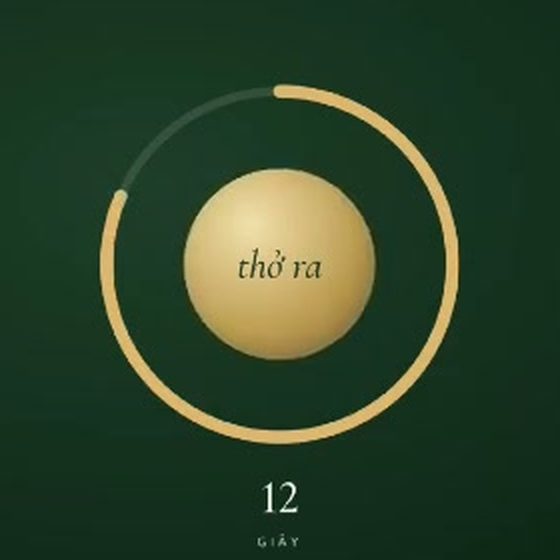
- Round 1, watch the circle. When it grows, breathe in; when it shrinks, breathe out. I reminded them: breathe as normal, no forcing. Eyes open is fine. Stop any time.
- A question between rounds. If you are made to breathe in deep and out slow again and again, even with “correct technique”, does it feel easier or tighter? Someone said: tighter.
- Round 2, follow my count. This time I said it plainly: now I am making you breathe. “Take a deep breath in. Breathe out really slowly… slowly… slowly.” A few breaths, then back to normal breathing.
- Ask again. Having to follow my rhythm, did it feel tighter?

Every command is a pressure.
Watching the circle, each person still knows if their own rhythm is fast or slow. Nobody is in control of them. Following my count, the breath has to chase someone else’s voice, and the word “slow” keeps stretching.
I call that forcing the brain to work. You want someone to settle, and the way you guide becomes one more thing to try hard at.
On the research: many studies find that slow, comfortable breathing goes along with changes in some heart measures, such as heart rate variability (HRV), during the breathing.3 One small study found that breathing out twice as long as breathing in raised the measures linked to the vagus nerve more than breathing in and out for equal lengths.4 But taking deep breaths again and again is something else. Breathing too deep and too fast can cause light-headedness, dizziness and a pounding heart.5
This was a class exercise, not an experiment. The two rounds differ in many things at once: who leads, how long the rhythm is, who is in control. I don’t conclude how the whole class felt. I just wanted each person to taste the difference before guiding others. On “take a deep breath”, see also Savasana cues for tired students and how to breathe in yoga.
Explaining it properly: mechanism, source, limits
Someone comes back from a singing bowl meditation and says: it was great, so relaxing. Ask why, and they don’t know.
For someone who practises, that is enough. For someone who teaches, it isn’t. “I feel”, “I like”, “I think” are impressions. Not an explanation yet.
Get the mechanism right. Cite the source. State the limits.
Limits are the part people skip most. Who was the study on, how many people, what was measured. One case, one small group, is not an answer for everyone.
To be fair: in that same class, while questioning the group, I said “sympathetic nerve” when I meant vagus and had to correct myself. A slip. Wrong, so fix it, right in front of the class.
One more thing I often say: when you really understand, you can explain it briefly. Needing a great many words is often a sign I don’t understand it yet myself.
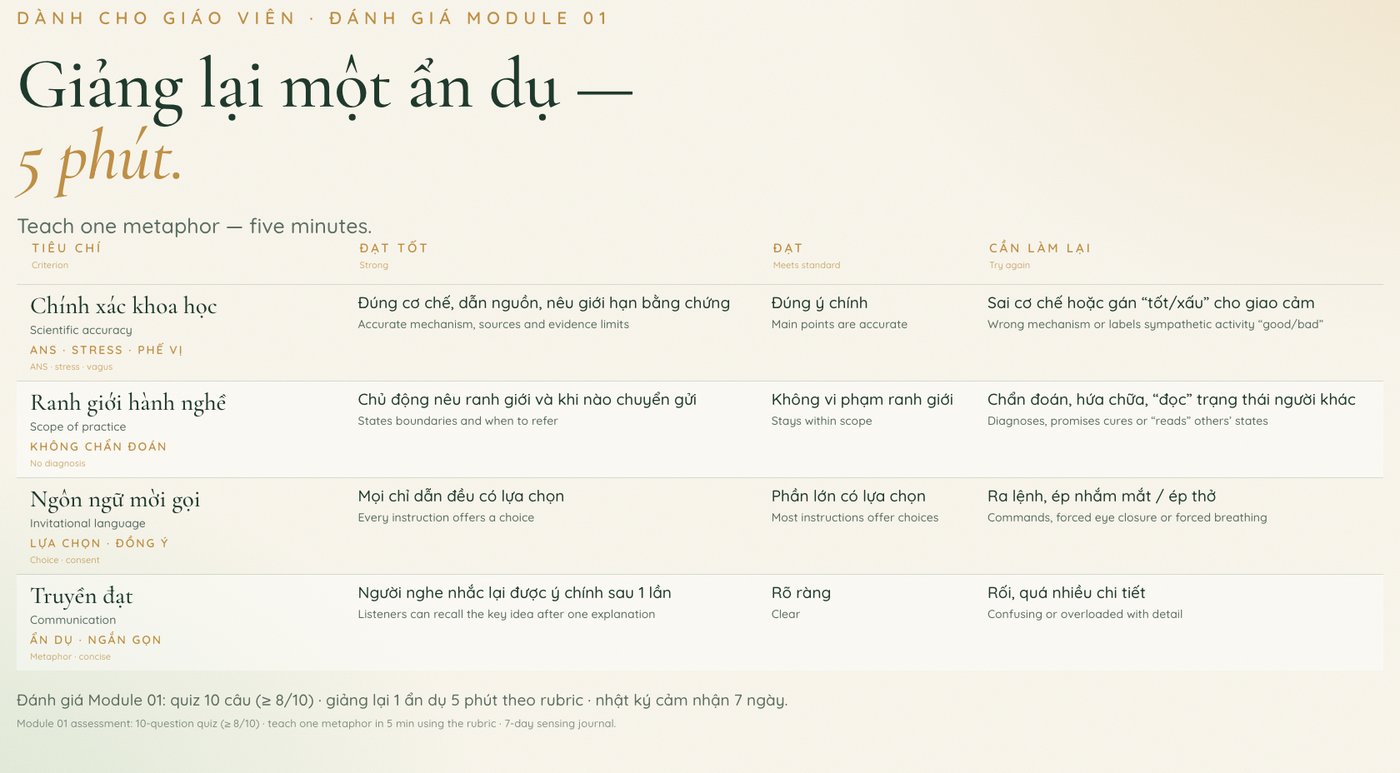
Score one sentence
“Child’s pose activates the parasympathetic system1, relieving all your stress2. Close your eyes and take a deep breath.3”
Tap each criterion to see where this sentence breaks.
1 Scientific accuracy
“Activates” sounds like flipping a switch. Both branches always run. What you can say: many people find it pleasant to rest in this pose.
2 Professional boundaries
“Relieving all your stress” is a promise. I don’t promise what I can’t check in another person.
3 Invitational language
Two commands in a row: close your eyes, take a deep breath. Add a choice, drop “deep”.
Rewritten
“If you like, stay in child’s pose for a few breaths. Eyes open or closed, either is fine. If it feels uncomfortable, come out any time.”
A yoga teacher is not a doctor
After learning sympathetic, vagus, window of tolerance, it is easy to feel you know a lot. Hear one story and you talk like a doctor with years of practice. You take on everything.
I said this when teaching 200 hours, and I say it again at 300 hours: I am a yoga teacher, not a doctor.
- Don’t diagnose. Even when you know the names of the conditions.
- Say your limits up front. What you can support, and what you can’t.
- Know when to refer. A serious bone, joint or muscle problem you don’t understand: ask the student to see a doctor, bring back the doctor’s guidance, then talk about what you can support within it.
In class I give you the exact words to say to the student:
“Go and see your doctor. Whatever the doctor says about exercise, come back and tell me, and I’ll support you within that.”
Bring scans to a yoga teacher to read, and the teacher takes on the treatment too? I can’t read scans. And even if someone taught me, I wouldn’t want that job just to look knowledgeable.
The same with the nervous system. Don’t say “your sympathetic system is too high”. I can’t see it. Let the student say what they notice, and keep what you see separate from a firm conclusion.
Try it now if you teach
- Find a sentence you often say with “sympathetic”, “parasympathetic” or “activates”. Ask it: when would this be wrong?
- Score it on the three criteria above: is the mechanism right, does it promise anything, does it give the student a choice?
- Next time you guide breathing, offer a rhythm to follow, but say clearly: breathing naturally is fine, stop any time.
- Try it on yourself first. One round breathing on your own, one round with someone counting for you. Where is the difference?
FAQ
Is the sympathetic nervous system bad?
No. It helps you focus, move and react to danger. The useful questions are whether it fits that moment, and whether the body can come back to rest afterwards.
What is the difference between sympathetic and parasympathetic?
The sympathetic system gets you ready to act: faster heart, muscles ready, a clear head. The parasympathetic looks after rest and digestion: the heart slows, the gut works, the body recovers. Both run together; what changes is which one leads at each moment.
When is the parasympathetic nervous system active?
All the time, leading more during rest, eating, digestion and recovery after effort. It doesn’t wait for Savasana to switch on.
What does a longer exhale than inhale do?
Some studies, mostly on healthy people with small samples, find that heart measures linked to the vagus nerve change during slow breathing with a longer exhale. That is a change during the breathing, not a treatment. Only a little longer, and stop where it feels comfortable.
Can yoga “switch off” the sympathetic nervous system?
Better not to say that. Much of a practice is movement, which still needs the sympathetic system. The rest at the end is different. The teacher chooses based on what was just practised and who is practising.
Should a yoga teacher tell a student their sympathetic system is high?
No. That is guessing someone else’s state. Ask how they feel, listen to the answer, and if there are signs of a medical problem, suggest they see a doctor.
Understand first, then support
Memorising two labels is easy. Knowing when a label is wrong is understanding.
In the 300-hour online yoga teacher training, the end-of-Module-1 assessment includes re-teaching a metaphor in 5 minutes, scored on the four criteria above. Only then do we move on to props and how to support the student.
It depends when.
Waxenbaum JA, Reddy V, Das JM. Anatomy, Autonomic Nervous System. StatPearls, NCBI Bookshelf. ncbi.nlm.nih.gov ↩
Cleveland Clinic. Sympathetic Nervous System (SNS). my.clevelandclinic.org ↩
Zaccaro A. et al. (2018). How Breath-Control Can Change Your Life: A Systematic Review on Psycho-Physiological Correlates of Slow Breathing. Frontiers in Human Neuroscience. A review on healthy people; the studies use very different methods. frontiersin.org ↩
Bae D. et al. (2021). Increased exhalation to inhalation ratio during breathing enhances high-frequency heart rate variability in healthy adults. Psychophysiology. A small study, 28 healthy people, measured during breathing. pubmed.ncbi.nlm.nih.gov ↩
Cleveland Clinic. Hyperventilation. my.clevelandclinic.org ↩
Sources and limits
The ideas come from an online class of the 300-hour yoga teacher training on 13 October 2026, the end of Module 1. The class was in Vietnamese. Speech was machine-transcribed and checked several times, but no one has re-listened to the whole class; the article retells ideas and does not quote students word for word. Three images are screenshots from the class; the rubric image is a course slide. The article does not conclude that any student understood or changed. The physiology is sourced in the notes; this is not medical advice.

Giang Hoang
Yoga teacher, E-RYT 500 & YACEP (Yoga Alliance)
Giang Metta Academy: RYS 200 & RYS 500 (YA ID 442630)
Based in Da Lat, Vietnam. Teaching online worldwide.