
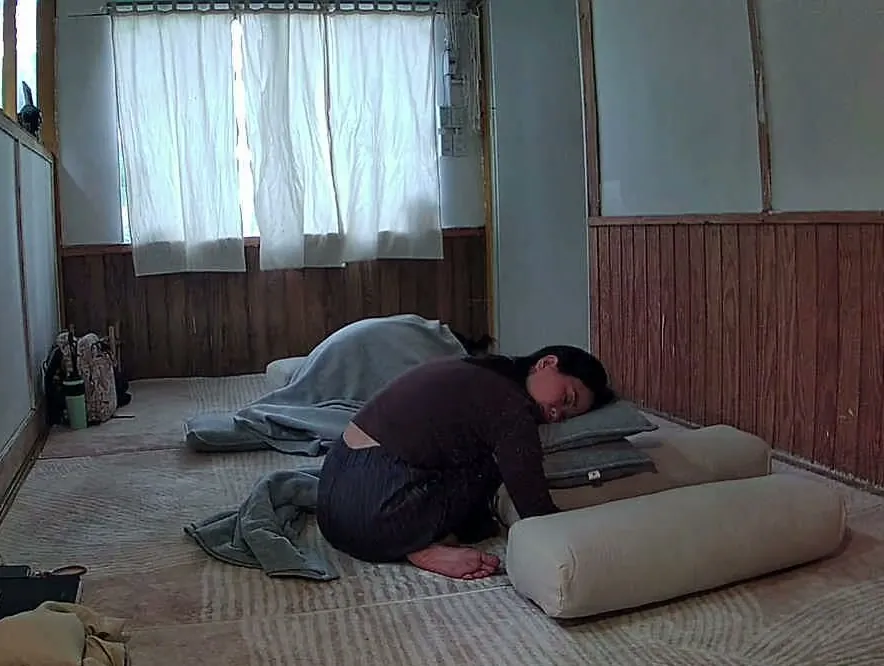
Quick read
Give another cue, or let the room go quiet?
Listen to the opening of the Yoga Nidra practice ↓
Give another cue when
- A participant asks a question. Be specific, then check whether it helped.
- You’ve just guided people into a pose and want them to notice their breath again.
- You want them to keep noticing a sensation.
Stay quiet when
- People are doing what you just asked: finding support, changing position or sitting up.
- Someone has just answered you. Listen before inviting them to stay in the pose.
- They’re lying down to rest.
Before you speakDoes the person lying there need another cue, or do they need time?
Ask a question, then wait for the answer
The Yin practice that day began lying down. One of my trainees was guiding it. I sat on the other side of the screen and listened.
The cues gave people time to find support and settle their legs before asking them to notice their breath. The trainee didn’t rush anyone to sit up, either: move your hands and feet, draw your knees in, roll to one side, then use your hands to sit up.
Those quiet stretches had a purpose. People were doing exactly what they’d just heard.
When they got to Pigeon Pose, someone asked where to put the towel.
Staying quiet wouldn’t help here. The trainee showed them where to put it under the back knee, then checked: can you lie down now? If not, raise the support.
It’s the question after the adjustment that tells me whether the first cue helped.
A forward fold with the legs stacked as in Cow Face Pose. Listen for “Is the stretch too intense?” and the answer. Then there’s nearly five seconds of quiet before the trainee invites the participant to stay in the pose.
Class recording · 37 secAdd a cushion, ask, then waitThe answer was no.
If you’re just looking at the shape, it’s easy to get busy lining up the knees. Here, the answer from the person in the pose matters more.
Same on the second side. Don’t use how low someone went on the first side as the target for the second. If the stretch feels stronger, add another cushion or block.
Worried about repeating cues, but missing a breath cue
Partway through Yin, my trainee was describing the hips and buttocks in quite a bit of detail. I chipped in: it’s been a while since you cued the breath. They answered, then brought the group’s attention back to the rib cage.
At the end, the trainee had a different worry: I keep saying the same few things.
My trainee asks about the Yin practice and I answer. Listen to the end: what the group needs isn’t new words.
Class recording · 29 secToo much repetition, or not enough breath cues?I don’t ask trainees to find a new way to say things every time they change poses. The people listening need a familiar rhythm to follow, too.
In this Yin practice, I spoke up because the trainee had spent a while describing the hips without bringing people back to the breath. In the same practice, while people were working out where to put their cushions, I wanted the trainee to give them time. Whether I’m guiding Yin or Yoga Nidra, I speak or wait depending on what people need right then.
I’ve written separately about Savasana cues for tired students and what can help them let go.
Reading a lesson plan isn’t the same as writing one
Take a lying-down leg stretch. If I want people to rest but they still need both hands to hold a leg, how are they supposed to relax their arms?
When I plan the class, I work out what will support the leg first. When I guide it, I show people where to put the support, then wait for them to lower the leg onto it. Once their hands no longer have to hold it, asking them to relax makes sense.
For what props do and where to put them, see where to put the block: under the lower back or the sacrum? For the difference between Yin and restorative yoga, see what changes even when both use cushions.
How much do you say when people are lying down for a long time?
Before the Yoga Nidra practice, my trainee asked me a very practical question: if people will be lying there for a while, do I need to keep reminding them to breathe?
I asked back: what are they lying down for?
You want them to stay with a sensation
A cue tells them what to notice.
You’re giving them room to rest
Call them back every few seconds and you fill the space you meant to leave for rest.
Here’s how the Yoga Nidra practice unfolded:
- Support from the ground
- An intention
- Moving attention through the body
- The breath as it is
- Heaviness and lightness
- Light and a forest
- Back to the intention
- Coming out of the practice
At the breathing stage, people were invited to notice the rhythm they already had. Not to breathe more deeply.
The opening of the Nidra practice. Listen as the trainee names each place the body touches the mat, and hear the quiet between them.
Class recording · 53 secLet the ground support youIn these 53 seconds, there’s only about 27 seconds of speech. The longest pause is almost nine seconds.
The trainee hasn’t left the group on their own. After each point of contact is named, the people lying down have time to feel it.
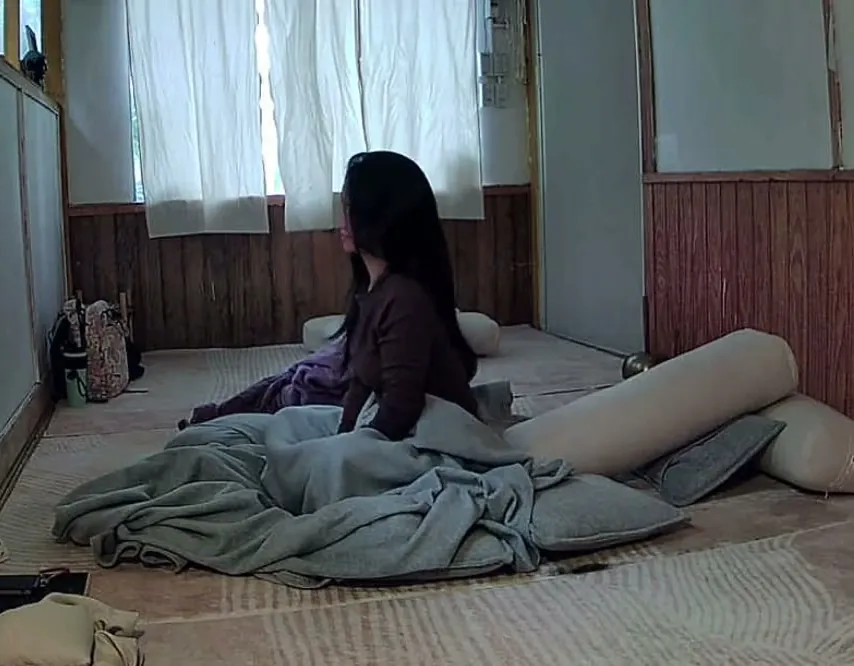
Coming out of the practice is guided, too: return to the sounds in the room, move your fingertips and toes, roll to one side, then sit up.
Afterwards, people asked each other if they’d slept. If someone said they’d dozed off, that was their own account. I don’t use who slept and who didn’t to grade the person who guided them.
There are two other Nidra practices, and more on dozing off, in Inside a Yoga Nidra and Yin teaching practice.
For teachers in training
Check your lesson plan
Pick two places in your plan:
- One where you’ve just given an instruction. Do people get a chance to respond?
- One where you’ve left a pause. During that pause, do people know what you’re inviting them to do?
These two questions are worth keeping more than a list of new words.
Speak when it helps.
This class is one example of the teaching practice and feedback included in the 90 hours of mentoring and case study work in the 300H Online course. See how the 300 hours are structured and where Yin fits in Module 4 of the curriculum.
About the recordings and images
This article is based on a 300H online class that lasted about three hours. The screen showed mostly slides and profile pictures, so I’ve used three unaltered audio excerpts rather than video clips. The two stills are from the practice room camera. The subtitles were transcribed from speech and checked in several passes using automated tools. Unclear lines were left out. Speech and silence durations are estimates based on the subtitle timings. Private feedback on the trainee’s voice and conversation after class were left out.